
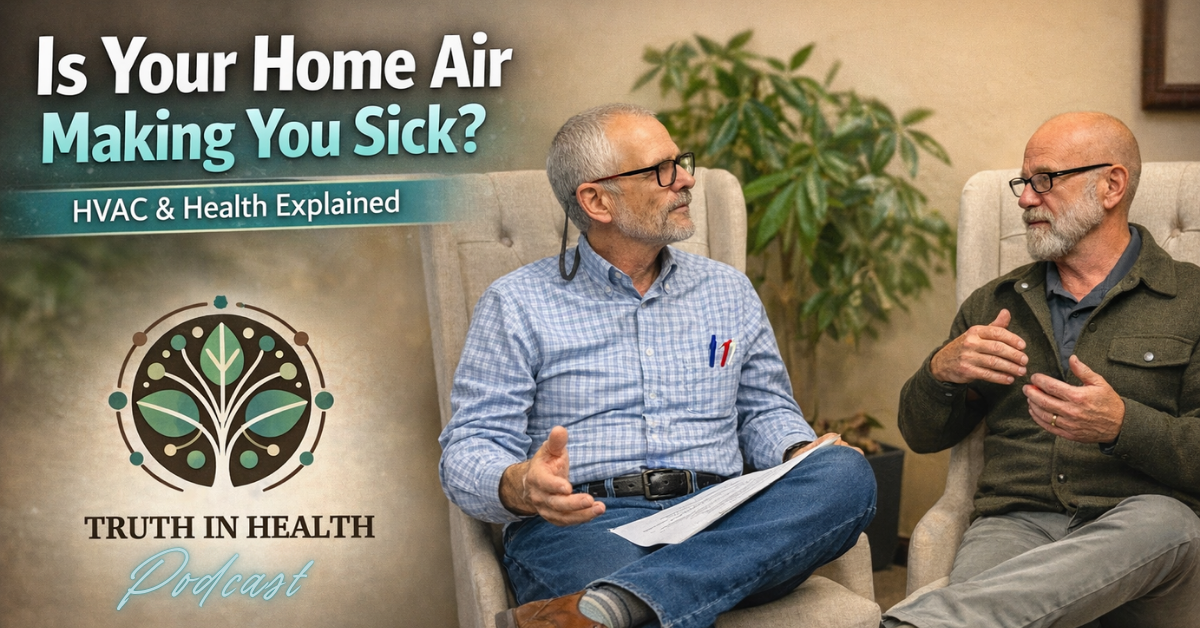
Chip Paul sits down with HVAC professional and Truth in Health founding member Chris Martin to explore how indoor air quality, humidity, airflow and HVAC maintenance can shape the home environment—and why what we breathe deserves a place in the health conversation.
Episode Timestamps
Watch the Full Episode
Is your home air affecting your health?
In this episode, HVAC expert Chris breaks down how air quality, humidity, mold, and airflow inside your home can impact how you feel every day—and what you can do to fix it.
00:00 Introduction – Why Air Quality Matters
01:10 Meet Chris Martin (HVAC Expert)
02:30 Why Indoor Air Impacts Your Health
04:10 First Signs of Poor Air Quality in a Home
06:00 Hidden Mold & Moisture Issues
08:20 Why “Clean Homes” Can Still Be Unhealthy
10:00 Airflow, Ventilation & Mold Growth Explained
12:15 Common Air Quality Warning Signs
14:00 Measuring Humidity, Airflow & Performance
16:00 Ideal Home Conditions (Temperature & Humidity)
18:10 Simple Ways to Improve Indoor Air Quality
20:30 HVAC Maintenance & System Lifespan
22:00 Air Quality in Workplaces & Rentals
24:00 New HVAC Systems & Refrigerant Changes
26:00 Repair vs Replace – What Homeowners Should Know
28:00 How to Contact Chris
29:00 Final Thoughts – Your Environment Matters
Watch the Episode

Listen to the Podcast
Indoor Air Quality & Your Health: Why HVAC Matters More Than You Think
Featuring Chris from CallChrisMartin.com | Truth in Health Podcast
Your health isn’t just about what you eat—it’s also about the air you breathe.
In this episode of Chip Talks Health, Chip sits down with HVAC expert Chris from CallChrisMartin.com to explore how indoor air quality, humidity, airflow, and HVAC systems directly impact your home environment.
From hidden mold risks to poor ventilation and outdated systems, this conversation reveals why even “clean” homes can still create health challenges—and what you can do about it.
Introduction: The Health Factor You’re Overlooking
When most people think about improving their health, they focus on food, supplements, movement, or sleep. They do not usually think about the air inside their home.
But the air we breathe is one of the most constant inputs into the body. If that air is carrying excess moisture, dust, mold, poor ventilation, or contaminants moving through an unhealthy HVAC system, it can quietly work against us every day. That framing is exactly how Chip opened this Truth in Health episode, pointing listeners toward a part of health people often overlook: the air they breathe in their home.
In this episode, Chip sits down with Chris from CallChrisMartin.com, a founding member of Truth in Health and a longtime HVAC professional, to talk about how heating, cooling, airflow, and indoor environmental conditions affect health inside the home. Chris shares that after connecting with Truth in Health, he began to see even more clearly that his work is absolutely part of the health space because what happens in a home’s environment affects the wellbeing of the people living there.
Why Indoor Air Quality Matters More Than People Realize
A home may look clean on the surface and still have unhealthy air.
Chris explains that one of the first clues can simply be the smell of the home. Sometimes the issue is visible, but often it is not. In many cases, the real problem is hidden inside the machine, on internal surfaces, in venting, or in the way air is being pulled through the structure. He also notes that water-driven issues like mold can be tied directly to the environment people are living in.
That matters because HVAC is not just about comfort. It affects airflow, filtration, moisture levels, and the movement of particles throughout the home. Chris specifically says that everything they do affects the health and wellbeing inside the home.
What Chris Looks for When He Walks Into a Home
According to Chris, one of the most obvious things he notices right away is the smell of the home. He may also notice clues at the vents, signs that filtration is not working well, or that the home is not sealed properly. Sometimes what people are actually smelling is contaminated air being pulled from a crawl space or another unhealthy area into the return system.
He explains that many problems are hidden and that he often needs to get inside the system itself to see where issues are concentrated. That includes checking surfaces inside the equipment where growth or buildup can occur.
This is a helpful reminder that a healthy-looking room does not always mean a healthy indoor environment.
Mold, Moisture, and Airflow: The Conditions That Create Problems
One of the strongest takeaways from the conversation is that mold is about conditions.
Chris describes a case in a multimillion-dollar home where mold was growing and being distributed through one of the best-operating air conditioning systems in the house. The deeper issue was not the price of the home or how clean it looked. It was improper venting and the lack of correct airflow conditions. Chris explains that when moisture is present and airflow or ventilation is poor, the environment becomes more supportive of mold growth.
That is a powerful point for homeowners. A home does not have to look dirty to have a moisture, airflow, or mold problem.
Signs Your Air Quality May Be Affecting You
This episode points to several warning signs that may suggest your home environment needs attention:
- Musty or unusual smells
- Excess dust or dirty-smelling air
- High humidity
- Uneven airflow
- Ongoing irritation or allergy-like symptoms
- Concerns about mold, moisture, or poor ventilation
Chris also points out that pet hair, dirty returns, and filtration bypass can contribute to larger air quality problems inside the equipment and the home.
Can Indoor Air Quality Be Measured?
Yes.
Chris explains that his team measures airflow, temperature, the refrigeration process, dew point, and moisture-related conditions as part of routine evaluation. He says that a common residential design target is around 75 degrees and 50 percent humidity, and that if a home cannot get humidity under control, something is likely going on that deserves attention.
He also mentions access to higher-level air quality testing and laboratory-style analysis when needed.
How to Improve Your Home’s Air
The good news is that many indoor air quality issues can be improved.
Chris talks about several possible ways to help a home environment, including:
- Routine HVAC maintenance
- Better filtration
- Sealing duct issues
- Managing humidity
- Bringing in controlled outside air when appropriate
- UV lights
- Ion devices
- Additional equipment for higher-grade air cleaning
He explains that most home systems are not automatically “health-making machines,” but they can be configured to clean air better and reduce problems significantly.
He also notes that his maintenance program includes a complete performance review and that he wants homeowners to understand what is happening in their system so they can make better decisions. He says the average residential system in Oklahoma often lasts around eight years, while the right lifespan is closer to twenty when things are maintained correctly.
Indoor Air Quality at Work Matters Too
This conversation is not only for homeowners.
Chris says commercial systems are often neglected just as much, if not more, than residential ones. He and Chip also discuss the risks this creates for renters, tenants, workplaces, and business owners when unsafe systems, moisture problems, or contamination are ignored.
For businesses, healthier indoor air is not just a comfort issue. It can affect employee wellbeing, productivity, and practical liability.
What’s Changing in HVAC Systems
Chris also talks about refrigerant changes and what homeowners should understand.
He explains that newer A2L refrigerants use less volume and improve efficiency, but are also mildly flammable, which is why newer systems include refrigerant detectors. He also explains that older systems can sometimes still be serviced and kept running, even when people are told otherwise, depending on the situation.
That kind of guidance is valuable for homeowners trying to decide whether to repair, replace, or wait.
Chris also mentions that energy-efficiency incentives may influence future buying decisions, particularly for more efficient equipment, though he describes that part as limited and developing information for Oklahoma.
Meet the Expert: Chris from CallChrisMartin.com
Chris is the owner of Call Chris Martin Mechanical, a founding member of Truth in Health, and a professional with decades of experience across the building trades. Chip introduces him as someone who has been in the business since 1986 and highlights his experience in heating, air, and home air quality.
If you want to learn more about Chris and his services, view his Truth in Health directory listing below:
Chris Martin Directory Listing
View Chris’s Truth in Health Listing
Chris also tells listeners that the best way to reach him is through callchrismartin.com, and Chip closes by directing viewers there as well.
Final Thoughts
Your home should support your health, not quietly challenge it.
This episode is a strong reminder that the air you breathe every day matters. Indoor air quality, airflow, moisture control, filtration, and proper HVAC maintenance all play a role in the environment your body lives in.
If you have never thought about your HVAC system as part of your health strategy, this is a good place to start.


