
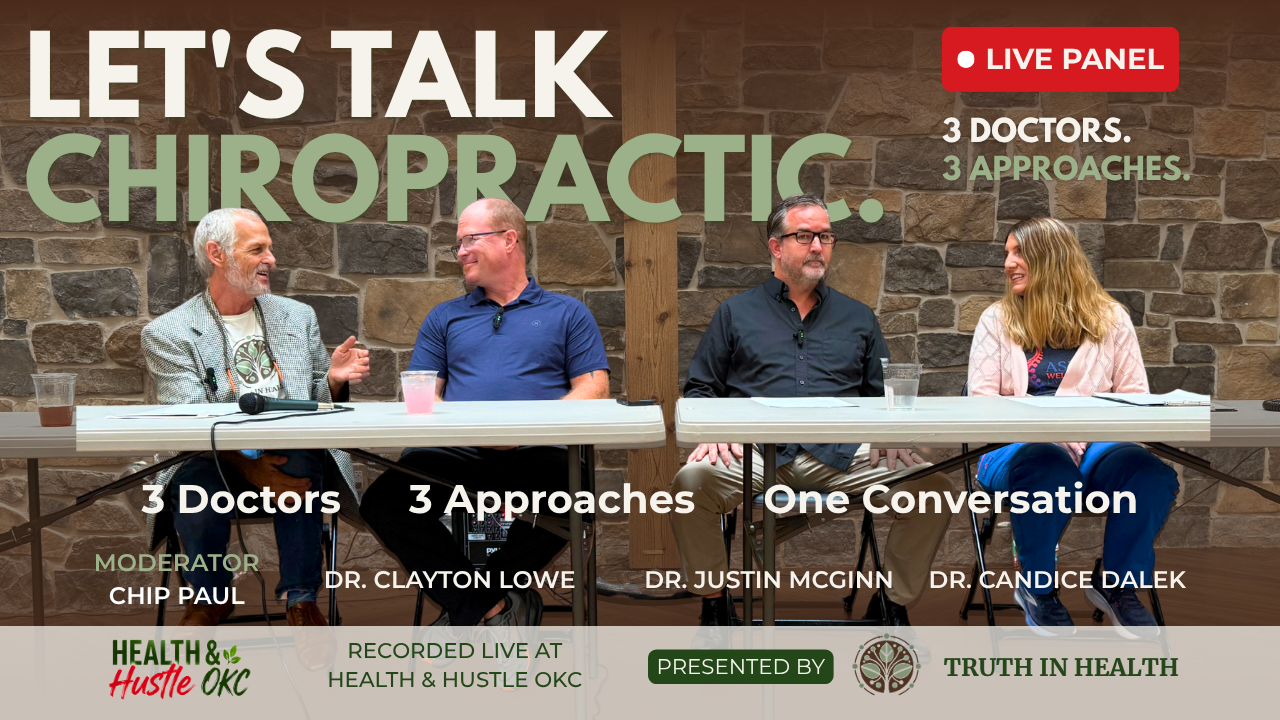
Chip Paul moderates a live chiropractic panel at Health & Hustle OKC with Dr. Clayton Lowe, Dr. Justin McGinn and Dr. Candice Dalek, bringing together three Oklahoma chiropractors with different approaches to discuss nervous system health, prevention, pediatric care, adjusting techniques, imaging and why finding the right chiropractor for you matters.
Episode Timestamps
00:00 Meet the Chiropractic Panel
01:13 Three Doctors, Three Different Approaches
03:39 Chiropractic, Prevention & Performance
05:27 Supporting Wellness Beyond the Chiropractic Office
07:19 What Makes Each Chiropractic Practice Different?
10:11 Pediatric Chiropractic & Does an Adjustment Need to “Pop”?
13:56 X-Rays, MRIs & Different Approaches to Imaging
17:03 Why These Doctors Chose Chiropractic
20:52 Memorable Patient Stories & Experiences
24:02 What Each Chiropractor Wants You to Know
28:24 Finding the Right Chiropractor for You
Watch the Episode

Listen to the Podcast
Three doctors. Three approaches. One conversation.
Chiropractic care isn't one-size-fits-all. Different chiropractors may use different techniques, technologies, philosophies and approaches to patient care—and understanding those differences can help people ask better questions when choosing a provider.
At Health & Hustle OKC, Truth in Health brought together Dr. Clayton Lowe, Dr. Justin McGinn and Dr. Candice Dalek for a live chiropractic panel moderated by Chip Paul.
Rather than debating which approach is best, the conversation gave each doctor an opportunity to explain how they practice and why. The panel covered nervous system health, prevention and performance, pediatric chiropractic, adjusting techniques, X-rays and imaging, referrals, and some of the questions people commonly have about chiropractic care.
Chiropractic Is Not One-Size-Fits-All
One of the clearest takeaways from the panel was how different three chiropractic practices can be.
Dr. Lowe described a traditional, energetic chiropractic environment that incorporates hands-on adjustments along with services such as acupuncture and therapy.
Dr. McGinn described a neurologically focused practice that primarily uses instrument-assisted adjusting and also offers technologies including spinal decompression, shockwave and Class IV laser.
Dr. Dalek described longer appointments that incorporate chiropractic adjustments with myofascial work and services such as acupuncture and dry needling, while also considering nutrition and lifestyle.
Those differences weren't presented as a problem. In fact, the doctors discussed referring patients to one another when another chiropractor offers a technique or service that may better fit someone's needs.
The takeaway for patients: ask questions and find a practitioner whose approach fits you.
Looking Beyond Back and Neck Pain
Many people first think about visiting a chiropractor when something hurts.
The panel broadened that conversation by discussing function, movement, performance and the nervous system.
Dr. McGinn emphasized neurological function and the relationship between the nervous system and the rest of the body. Dr. Lowe discussed a more proactive approach to spinal care rather than waiting for pain to appear. Dr. Dalek expanded the conversation beyond the chiropractic office to include exercise, nutrition and other lifestyle factors.
The discussion reinforced an important principle of whole-person wellness: no single intervention exists in isolation. Movement, nutrition, sleep, appropriate healthcare and other lifestyle factors can all be part of an individual's larger health picture.
Does a Chiropractic Adjustment Have to “Pop”?
It's one of the questions people commonly associate with chiropractic care:
Does an adjustment have to crack or pop to work?
The three chiropractors agreed that an audible sound is not the goal of an adjustment.
Dr. McGinn explained that his practice primarily uses instrument-based adjusting and does not rely on a traditional audible "pop." Dr. Lowe described the sound as a pressure change within a joint rather than an indication that an adjustment was successful. Dr. Dalek likewise explained that she does not require a pop as part of her approach.
For someone hesitant about chiropractic because of the idea of being "cracked," this is a useful question to ask a prospective provider:
What adjusting techniques do you use?
What Does Chiropractic Care Look Like for Children?
The panel also addressed pediatric chiropractic.
All three doctors emphasized that the amount of force and techniques used with children differ from those used with adults.
Dr. Dalek described a very light approach and discussed craniosacral techniques. Dr. McGinn explained that children require adjustments appropriate to their size and circumstances. Dr. Lowe described the pressure used with small children as being very light.
Parents considering chiropractic care for a child should ask about the provider's pediatric training, techniques, rationale for care, potential risks and benefits, and available alternatives.
Why Don't All Chiropractors Use X-Rays the Same Way?
One of the most interesting parts of the panel was the discussion about imaging because the doctors didn't all take the same approach.
And that was precisely the point of bringing different practitioners together.
Dr. McGinn described using X-rays as part of evaluating spinal structure and, in some circumstances, comparing changes over time. He also discussed circumstances in which MRI may provide additional information.
Dr. Lowe described routinely using X-rays during his evaluation and referring for additional imaging when necessary.
Dr. Dalek explained that she doesn't routinely begin with X-rays in her office and instead refers patients for imaging when she believes it is warranted.
Patients should feel comfortable asking any healthcare provider:
Why are you recommending this test, and how will the results affect my care?
Sometimes the Right Answer Is Another Provider
Another encouraging theme was collaboration.
The doctors openly discussed referring patients to other chiropractors and healthcare professionals.
Dr. Lowe, for example, explained that he may refer someone to Dr. McGinn for services such as decompression or shockwave that aren't offered in his office, or to Dr. Dalek for techniques such as dry needling.
Dr. McGinn also acknowledged something patients sometimes overlook: personality and treatment preferences matter. A patient may simply be more comfortable with another chiropractor's approach.
Good healthcare doesn't have to be competitive.
Sometimes serving someone well means knowing when another professional should be part of their care.
The Personal Stories Behind the Doctors
Chip also asked each panelist what led them to chiropractic.
Their answers revealed very different paths.
Dr. McGinn shared how his childhood experiences with asthma and chiropractic influenced his eventual career path.
Dr. Dalek discussed her experience with migraines and health challenges within her family, which contributed to her interest in chiropractic, nutrition and broader wellness approaches.
Dr. Lowe traced his introduction to chiropractic to a sports-related shoulder injury and described how his passion eventually grew into helping people improve function and performance.
These are personal experiences—not evidence that another person will experience the same outcomes—but they help explain the passion each doctor brings to their work.
Finding the Right Chiropractor for You
Chip closed the conversation with a simple message:
Find your match.
The three doctors on the panel share a profession, but their techniques, office environments, philosophies and services are distinctly different.
If you're considering chiropractic care, some useful questions to ask include:
- What techniques do you use?
- What does a typical visit look like?
- What are you evaluating?
- Why are you recommending imaging or a particular treatment plan?
- How will we evaluate progress?
- What are the potential benefits, risks and alternatives?
- When would you refer me to another healthcare professional?
Being an informed patient doesn't mean knowing all the answers.
It means feeling comfortable asking the questions.
Better Together at Health & Hustle
This panel captured exactly what we hoped to create through Health & Hustle OKC.
Three professionals with different approaches sat at the same table, shared their perspectives, acknowledged their differences and talked about how they can work together to help people find the care that's right for them.
That's the kind of conversation Truth in Health wants to encourage.
Education over confusion. Collaboration over competition. Community over silos.
We're Better Together.
About the Panel
Moderator: Chip Paul
Panelists:
Dr. Clayton Lowe
Dr. Justin McGinn
Dr. Candice Dalek
Recorded live at: Health & Hustle OKC
Presented by: Truth in Health
Medical Disclaimer
This article and recorded discussion are provided for educational and informational purposes only and are not intended to provide medical advice, diagnosis or treatment. Panelists share their individual professional perspectives and personal experiences. Statements made by individual speakers do not necessarily represent the views of Truth in Health or Health & Hustle OKC. Consult an appropriately qualified healthcare professional regarding your individual health needs.
View Full Transcript
3 Doctors. 3 Approaches. One Conversation.
Recorded live at Health & Hustle OKC
Moderator: Chip Paul
Panelists: Dr. Clayton Lowe, Dr. Justin McGinn and Dr. Candice Dalek
This transcript has been lightly edited for readability. Filler words, repeated phrases and obvious transcription errors have been removed, and names have been corrected. The substance of the speakers’ comments has been preserved.
Introduction
CHIP PAUL:
We’re getting ready to start the chiropractic panel. Thank you guys, first of all, for attending.
In chiropractic practices, there are a lot of nuances. One of the things we really want you to understand and highlight today is the different approaches each of these chiropractors has.
Each of them practices in a little different way. They focus on different things and different features.
Listen to what they have to say. If you’re looking for a chiropractor, you want somebody who matches your needs, your personality and your vibe.
With us today, we have Dr. Clayton Lowe, Dr. Justin McGinn and Dr. Candice Dalek.
We’re going to let each of them talk a little bit about their practice and what they do, and then we’ll drill down and ask them some questions.
Dr. Lowe, tell us a little bit about your practice.
Meet Dr. Clayton Lowe
DR. CLAYTON LOWE:
I’ve been in practice for 28 years. I practiced in Iowa for 25 years and moved down to Oklahoma City two years ago.
Our office here is basically your simple chiropractic office. We do adjustments, some acupuncture, therapy, stretching and things like that.
The primary thing is that we want to know what’s going on with your health. One of the ways we do that is by taking X-rays to find out what’s going on, and then we come up with a course of action for you to follow.
Meet Dr. Justin McGinn
CHIP:
All right, Dr. McGinn.
DR. JUSTIN McGINN:
Hello. My name is Justin McGinn. I’m a chiropractor in Edmond, Oklahoma.
We are a multigenerational practice. We started about 50 years ago and were the second chiropractic practice in Edmond when Dr. Hanson’s dad started the practice.
We focus on health from a neurological standpoint. We want to make sure that your brain and nervous system are functioning well.
It’s not always just about pain.
We have some things that we do to help with pain outside of chiropractic, but chiropractic is our main focus. We also do a lot with spinal decompression. We have a shockwave machine here with us today if you want to come experience that. We also do Class IV laser and some other things like that.
Chiropractic is mainly what we want to emphasize and what we’re going to be talking about today.
Thanks for coming.
Meet Dr. Candice Dalek
DR. CANDICE DALEK:
Hello. My name is Candice Dalek, and I own Aspire Wellness Living.
I do different types of chiropractic. I also do dry needling and acupuncture, and we incorporate nutrition.
I spend about 20 to 30 minutes on adjustments. We do myofascial tissue work before administering the adjustment.
Prevention & Performance
CHIP:
We’ve gotten a little bit about what each of these chiropractors does and about their practices.
Now we’re going to drill into some questions.
We’ll start by talking about prevention and performance.
Dr. McGinn, what can optimizing function look like for an everyday person—not just a professional athlete?
DR. McGINN:
There are two ways to answer that question.
I think professional athletes and very sick people may notice some of the most significant results because they’re at opposite ends of the health spectrum.
You have someone who is very sick and having a lot of issues. We go in and start working with their nervous system, and they may begin noticing changes.
Then you have the professional athlete who is at the very top of their game. When you give them a neurological edge in terms of the way their body adapts and the efficiency of their nervous system, they’re looking for even very small improvements.
What’s the difference between $3 million in a horse race? It might be half a nose. They’re looking for that performance edge.
You can adjust me and my golf game may not noticeably improve because I’m not at that edge with my golf game.
For me personally, asthma is actually what got me interested in chiropractic.
I was a normal kid having problems with asthma. My grandma finally took me to a chiropractor, and that’s when I started noticing a difference.
For the average person, sometimes changes may be harder to see, but the principle for us is that the nervous system is involved throughout the body, and we want it functioning as well as it can.
Wellness Outside the Chiropractic Office
CHIP:
Very good.
Dr. Dalek, what can people do outside of the chiropractic office to support their overall wellness?
DR. DALEK:
That’s a good question.
Outside of the office, I suggest looking at nutrition. But it’s really about the daily lifestyle you choose.
Exercise is important. Infrared saunas can be beneficial. I think looking at your gut biome is extremely important.
There are many different things you can do outside of the chiropractic office to support your wellness.
Why Wait Until Something Hurts?
CHIP:
Dr. Lowe, why shouldn’t someone necessarily wait until they’re hurting to think about how their body is functioning?
DR. LOWE:
When you think about it, your nervous system is involved throughout your body, and it’s not just about pain.
You may have other symptoms or something that doesn’t necessarily present as direct pain.
The way I look at it is this: We brush our teeth every day. Do our teeth hurt? Hopefully not.
We brush our teeth every day so they stay healthy.
I think about our spine and health similarly. Regular care is intended to help keep the body functioning well.
What Makes Each Practice Different?
CHIP:
Can each of you talk a little bit about what makes your practice unique?
What do you do that’s a little different from another chiropractor?
And would you ever cross-refer patients to one another?
Dr. Lowe?
DR. LOWE:
My practice is a little different.
We do what we call open-bay adjusting. The tables are right out in the open, so everybody can see what’s going on. There’s nothing hidden.
And my music, I’ve been told, is a little loud at times. We do that to keep the energy up and everything going.
As far as referring to other doctors, I refer to these guys.
I don’t do shockwave in my office or decompression, so I could refer to Dr. McGinn for that.
If somebody needs something like dry needling, I do acupuncture in my office, but if they need dry needling, I could ask Dr. Candice to take care of them.
DR. McGINN:
Our office is a little different because we do instrument adjusting, which means it’s not as hands-on as someone might typically think of chiropractic.
It’s very gentle and neurologically focused. Instead of one larger force, we’re putting in a number of smaller inputs.
We also do shockwave, laser and decompression in addition to what we do chiropractically.
As far as going to different chiropractors, there are some people who absolutely love what we do—the gentler approach—and they might not be happy in another office.
Then I have people come in who want something different. I’m not going to try to force what we do on them. I can say, “If this is what you’re looking for, this is where you should go.”
Sometimes it’s simply a personality thing.
Not everybody likes us. Maybe it’s because my shirt is black and they don’t like people with black shirts, so they need to go to somebody with a blue shirt!
I don’t always know.
But we’re happy to refer.
All of us have the same mindset in that we’re looking to get the Oklahoma City, Edmond and surrounding communities to a healthier place.
A healthier community is better for all of us. It can be a safer community and a more productive community.
We’re here for you, and we want to help you find the best place possible.
DR. DALEK:
Aspire Wellness Living is different because we are a home-based office.
We spend 20 to 30 minutes with each of our patients, and we look at the whole body as a unit.
We’re doing myofascial work as well as the adjustment, acupuncture and dry needling.
We intentionally spend a lot of time with the patient.
Pediatric Chiropractic & the “Pop”
CHIP:
Can you each talk a little bit about how you handle children in your practice?
Is care for kids different from adult care?
And then let’s talk about another common question: Are we “cracking” people? Does there always need to be a pop when you adjust somebody?
Dr. Dalek, let’s start with you.
DR. DALEK:
A chiropractic adjustment for a child is a lot different.
My approach is very light and can be more like craniosacral therapy.
You don’t need to create a pop with a young child’s vertebrae. I don’t even need a pop from an adult.
DR. McGINN:
In a lot of ways, kids are just tiny people, right?
We treat them with many of the same principles, but there’s a difference in the amount of force needed and even the amount of time.
They’re more resilient. They haven’t been carrying the same issues for 40 years by the time they come in to see me.
We do instrument adjusting, so we’re not getting the loud, audible crack that you might hear in another type of office.
For us, we’re looking for that neurological input and connection. You can accomplish that in a number of ways.
DR. LOWE:
The pop itself is a release of pressure within a joint.
You don’t need a big pop to perform an adjustment.
As far as adjusting kids, it’s the same principle these guys have talked about. They’re smaller people, so we use different techniques and different approaches.
We don’t just throw them against the wall and see what sticks!
With children, the pressure can be very light—sometimes I compare it to the amount of pressure it takes to roll a pencil across a table.
Whether you use an instrument or your hand, it can be very little pressure.
Sometimes kids will pop louder, and we just say, “Well, you’re full of popcorn today,” and make it fun for them.
X-Rays, MRIs & Imaging
CHIP:
Imaging has become increasingly important across healthcare.
How do each of you work with imaging? How are you getting the diagnostic information you need for care?
Dr. McGinn, do you want to start?
DR. McGINN:
As far as imaging goes, there are a few different ideas about that.
As chiropractors, we trust our hands quite a bit. Everything else is added information.
In my office, for instance, we do thermal imaging to start, and we use X-rays as well because we want to have a good overall map.
The day-to-day visit may involve using my hands to determine what we’re working on that day, but we also have a broader structural picture.
I like to use before-and-after X-rays, especially in the beginning, because I want to check our work.
If I say we’re working toward a structural change, I want to see whether we’re actually moving in that direction.
MRIs can also be useful. I don’t always refer for them, but occasionally they’re appropriate.
A lot of people bring previous imaging with them, particularly if they’ve been dealing with disc issues or have seen another provider.
DR. DALEK:
I don’t start out with X-rays in my office.
I use other assessment techniques first. If we’re not getting results or I believe additional information is needed, I refer out for X-rays.
I also refer out for MRI when appropriate.
DR. LOWE:
We take X-rays when someone first comes in.
We’re looking at the curves of the spine and overall structure.
Those curves are important for how the body handles gravity and movement.
We refer out for MRI, ultrasound or other imaging if needed, but X-ray is one of the primary tools we use in our office.
Why Chiropractic?
CHIP:
You’re all passionate people.
You got into chiropractic because you wanted to help people and were passionate about what you wanted to do.
Can you talk about that passion and what led you into your practice?
DR. McGINN:
For me, it started with my personal health experience with asthma.
That’s what initially put me on the path, although it took years before I found my way into chiropractic school.
The passion for what we do is really about helping people experience what their body can do.
The nervous system is a communication system throughout the body, and our philosophy is centered around supporting that communication.
That’s a big part of what drives me.
DR. DALEK:
My passion started when I was around 20 years old and continuously experiencing migraines.
I decided I needed to see a chiropractor, and that experience became part of my journey.
Later, my daughter dealt with severe asthma, and my son experienced significant health challenges.
Those experiences contributed to my interest in chiropractic, nutrition and the testing we incorporate into my office today.
DR. LOWE:
My passion for chiropractic started with sports.
I had a shoulder injury, saw a chiropractor and got interested in the profession.
My passion has evolved, but it’s still primarily about taking people who aren’t performing the way they want to and helping them work toward functioning better—whatever area of their life that may involve.
When you see someone reach a point where they realize they’re feeling or functioning better, those moments feed your passion because you know you’re making a difference in somebody’s life.
Memorable Patient Experiences
CHIP:
Let’s talk about some of the most memorable experiences you’ve had in practice.
Anyone who does clinical care and works with people over a long period of time has stories that stay with them.
What are some of yours?
DR. DALEK:
I worked with a child years ago who had been described as experiencing failure to thrive and wasn’t growing as expected.
That experience and watching the child’s progress over time is something that has stayed with me.
DR. McGINN:
I think sometimes the biggest experiences are the ones we don’t necessarily see coming.
I would much rather take care of a healthy person throughout life and hopefully never have a crisis where we’re looking for a “miracle.”
But one experience that came back to me was a patient I had been seeing.
One day, he told me, “I don’t know if you know this, but I was planning on killing myself before I came and saw you months ago, and this has totally changed my life.”
You don’t always know what’s going on with somebody.
They may tell you about shoulder pain or back pain, but there can be other things happening in their life.
That experience hit me pretty hard. It was fairly early in my practice and made me recognize the importance of connecting with and caring for the whole person.
DR. LOWE:
I had a midwife call the office one time about a pregnant patient whose water had broken and whose baby was breech.
I told her to bring the patient in. She came in right before lunch and looked incredibly uncomfortable.
We adjusted her and used a couple of acupuncture points, and then she went on her way.
Later, I received a letter in the mail—which tells you how old I am because it wasn’t an email!
There was a picture of the baby boy.
By the time she arrived at the hospital, the baby had changed position enough that she was able to deliver vaginally without the assistance she had expected.
That was one of those experiences that stayed with me.
Final Takeaways
CHIP:
We’re going to start closing things down.
I’d like each of you to take a couple of minutes and tell the people here one thing you want them to take away from this experience about you, your practice or chiropractic care.
Dr. Lowe?
DR. LOWE:
The biggest thing I want people to understand is that health and healing take time.
There are things that may make you feel better quickly, but chiropractic care, from my perspective, is about working with the body over time.
Think about when you break a bone or sprain an ankle. Healing takes time.
We work with that process rather than against it.
My background includes working with athletes, and we also incorporate acupuncture and other approaches, but the overall goal is helping people function better.
DR. McGINN:
One of the things I try to get across to everyone who comes into our office is a simple five-word principle:
Proper structure equals proper function.
We do a lot of corrective care, and we may compare X-rays because we want to check our work.
But the idea isn’t simply to make an X-ray look better.
Our philosophy is that the structure of the spine and the function of the nervous system are connected, and we want the body functioning as well as it possibly can.
DR. DALEK:
I intentionally named my business Aspire Wellness Living.
I want to inspire people to look outside the box and to aspire toward wellness.
I want people to think about what they can do to support their own health.
For me, that includes looking at nutrition and other aspects of wellness in addition to chiropractic care.
Find Your Match
CHIP:
Excellent.
I want to thank each of these wonderful doctors for being here today.
I think you’ve heard that each of them has a different approach to chiropractic care.
And that’s important.
As you go out and look for a chiropractor, find a chiropractor who matches you—your lifestyle, your personality and what you’re looking for.
You can see just from these three approaches that chiropractic practices can vary quite a bit.
Find your match.
If you’re interested in learning more, each of these three doctors has a booth here today. Find their booth, talk to them and learn more about what they do.
Let’s give them all a big hand for being here today.
Thank you, Dr. Clayton Lowe, Dr. Justin McGinn and Dr. Candice Dalek.
DR. McGINN:
Thanks for having us.
DR. DALEK:
Thank you.
DR. LOWE:
Thank you.
Editor’s Note: This transcript has been lightly edited for clarity and readability while preserving the substance of the live conversation. The panelists’ comments reflect their individual professional opinions, clinical experiences and personal stories and should not be interpreted as medical advice or as claims endorsed by Truth in Health.


