
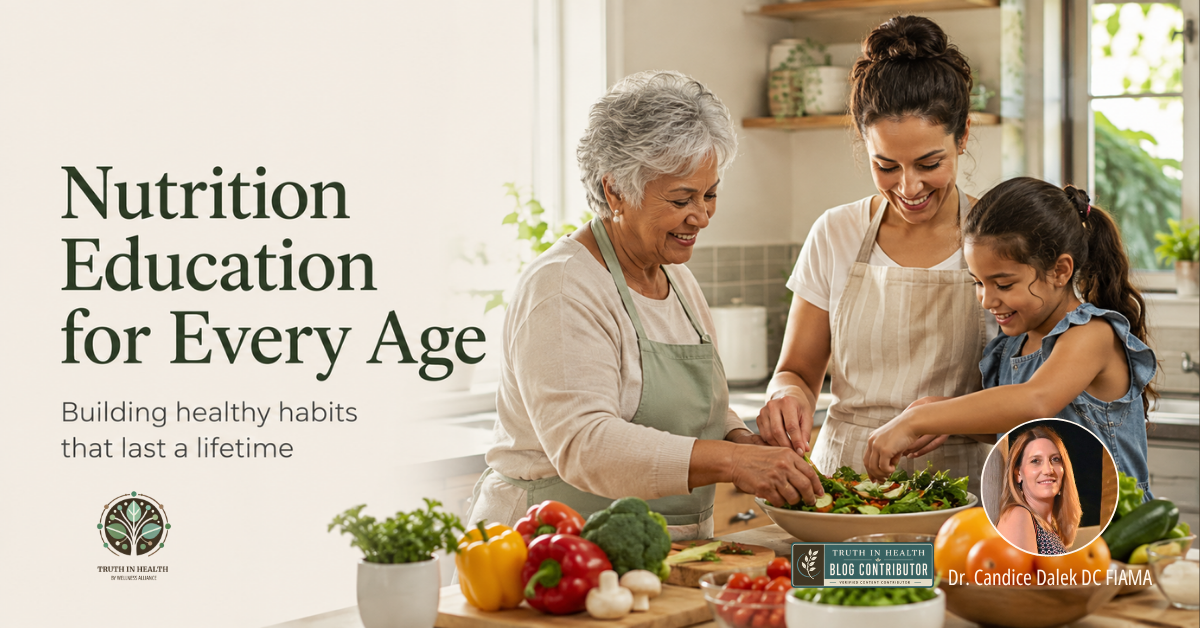
Americans may be living longer, but are we adding health to those years? Dr. Candice Dalek explores how nutrition education, health literacy, and small daily choices can help families build healthier habits for life.
Americans are living longer than generations before us. But there is an important question we don't ask often enough:
Are we actually living healthier?
Longer life expectancy does not automatically mean more years filled with energy, strength, mental clarity, mobility, and well-being.
Today, families are navigating chronic disease, obesity, digestive problems, fatigue, sleep difficulties, anxiety, depression, and other health challenges—often beginning at surprisingly young ages.
A large 2025 study published in JAMA documented troubling changes in the health of American children and adolescents, including increases in chronic conditions and concerns such as anxiety, depression, obesity, and sleep apnea.
That should make every parent, grandparent, caregiver—and really every one of us—ask:
What has changed, and what can we do differently?
There isn't one simple answer.
Our health is influenced by genetics, environment, stress, sleep, movement, socioeconomic circumstances, medications, access to health care, relationships, and many other factors.
But there is one thing we interact with several times every single day:
Food.
And that gives us an opportunity.
The American Food Environment Has Changed
Walk through a grocery store today and you'll see thousands of brightly packaged products promising convenience, flavor, energy, and even "health."
But convenience can come with a nutritional cost.
CDC data from August 2021 through August 2023 found that 61.9% of calories consumed by American youth ages 1–18 came from ultra-processed foods. Among adults, it was 53%.
Think about that.
More than half of our calories are coming from ultra-processed foods.
These foods can include sweetened beverages, packaged goods, candy, chips, sugary cereals, fast food, frozen convenience meals, and other heavily processed products.
This doesn't mean every food that comes in a package is "bad," and healthy eating doesn't require perfection.
It means we need to reconsider what has become normal.
Whole and minimally processed foods can form the foundation of our diets—not the occasional exception.
Your Grocery Cart Is One of Your Most Powerful Health Tools
We make decisions about our health every time we walk through the grocery store.
One of the most valuable skills we can teach ourselves—and our children—is surprisingly simple:
Learn to read the label.
Don't stop at the advertising on the front.
Turn the package around.
Look at the serving size. Check added sugars, sodium, saturated fat, protein, and fiber. Then read the ingredient list.
Ask yourself:
- How much added sugar am I actually getting per serving?
- How much sodium is in this product?
- Does it provide fiber or protein?
- How large is the serving compared with what I will actually eat?
- Are whole foods among the first ingredients?
- What does the ingredient list tell me about the product I'm choosing?
And remember that children's nutritional needs are different from adults'. A serving or Daily Value printed on a label should not automatically be interpreted as the appropriate amount for every child.
The goal isn't to become afraid of ingredients.
The better goal is to become an informed consumer.
Compare products. Ask questions. Learn what you're feeding your family. Then make the best choice you reasonably can.
A child who learns to do this at eight years old is developing a skill that can last a lifetime.
Because healthy eating shouldn't begin after someone becomes sick.
Nutrition education should be part of growing up.
Our Children Are Watching What We Do
We can tell children to eat vegetables all day long.
But what they see us doing may be far more powerful.
When children see adults drinking water, preparing vegetables, eating adequate protein, choosing fruit, cooking meals, moving their bodies, prioritizing sleep, and sitting down together to eat, we're teaching something far bigger than nutrition.
We're demonstrating what caring for a body looks like.
We can also teach children that food has many purposes. It fuels us, nourishes us, connects families and cultures, and can absolutely be enjoyed.
The goal isn't to create fear, guilt, or an obsession with eating "perfectly."
The goal is to help children develop a healthy relationship with food and an understanding of how their choices affect the way they feel and function.
That is a life skill.
We Don't Need Perfect Diets. We Need Better Habits.
Nutrition can feel unnecessarily complicated.
One expert tells us to avoid one food. Someone online tells us that same food is essential. Packages carry health claims. Social media delivers another diet trend every week.
It can become exhausting.
So simplify it.
Instead of asking, "Am I eating perfectly?" start asking better questions:
- How much of my diet comes from whole or minimally processed foods?
- How many different fruits and vegetables am I eating?
- Am I getting enough protein and fiber?
- Am I drinking enough water?
- How frequently am I relying on ultra-processed foods?
- Do I understand what I'm buying and why I'm buying it?
- What is one realistic improvement I can make this week?
Then start there.
Not with an extreme diet.
Not with throwing away everything in the pantry.
Not with guilt.
With one better habit.
- Replace one sugary drink with water or herbal tea.
- Add another vegetable to dinner.
- Choose a protein-rich meal or snack that works for your routine.
- Put real fruit where your children can easily reach it instead of a fruit snack gummy.
- Cook one more meal at home each week.
- Compare two labels before choosing a product.
- Let your child pick a new vegetable or fruit at the grocery store.
Small choices don't look dramatic.
But small choices repeated hundreds and thousands of times become a lifestyle.
Healthy Children Can Become Health-Literate Adults
Perhaps one of the most valuable things we can give our children isn't something that comes in a bottle.
It's education.
- Teach them what protein does.
- Teach them why fiber matters.
- Teach them where food comes from.
- Teach them how to recognize added sugar.
- Teach them how to read a nutrition label.
- Teach them how to prepare a few simple meals.
- Teach them why their bodies need movement.
- Teach them why sleep matters.
- Teach them that hydration, relationships, sunlight, activity, nutrition, and mental well-being are all pieces of health.
- Teach them that taking care of their bodies isn't punishment.
It's a form of respect.
And most importantly, model it.
A child who enters adulthood understanding how to shop for food, read a label, prepare a meal, move their body, prioritize sleep, and recognize when something doesn't feel right has something incredibly valuable:
Health literacy.
Your Health Deserves a Plan
We cannot personally redesign America's food system overnight.
We can't control every advertisement our children see.
We can't eliminate every ultra-processed food from the world.
And we certainly can't control every choice our children will eventually make for themselves.
But we can change what happens inside our own homes.
- We can become label readers.
- We can ask better questions.
- We can prioritize nutrient-dense foods more often.
- We can cook with our children.
- We can talk openly about nutrition.
- We can teach children why their bodies need certain foods instead of simply giving them another list of things they're not allowed to eat.
- We can stop waiting for illness to be the reason we finally become interested in health.
At Aspire Wellness Living, we believe wellness is something we practice—not something we think about only when something hurts.
Whole-person health means becoming curious about the many pieces that influence how we feel, function, grow, and live.
Imagine what could happen if we raised a generation that didn't have to relearn healthy living at 30, 40, or 50 because they learned the fundamentals at home.
Imagine children growing into adults who understand their bodies, question marketing claims, read labels, prepare real food, recognize unhealthy habits, and know that taking care of themselves is simply part of everyday life.
Living longer is wonderful.
But I want more for our families than simply adding years to life.
I want us to add health to those years—more energy, clarity, strength, resilience, connection, and purpose.
And that doesn't begin with perfection.
It begins with education.
It continues with daily choices.
And eventually, those choices become habits.
Your next healthier choice doesn't have to be dramatic. It simply has to be your next one.
This article is for educational purposes and is not intended to diagnose, treat, cure, or prevent disease. Individual nutritional needs vary, particularly for children and people with medical conditions. Discuss significant dietary changes or supplementation with an appropriate qualified healthcare professional.
About the Author
 Dr. Candice Dalek, DC, FIAMA
Aspire Wellness Living
Dr. Candice Dalek is a chiropractor and acupuncture practitioner with more than two decades of experience. Through Aspire Wellness Living in Edmond, Oklahoma, she provides individualized, whole-person care designed to help patients better understand and support their health and wellness.
Phone: 719-453-4630
Location: 1819 Duckhawk Court, Edmond, OK 73003
Practice: Aspire Wellness Living


