
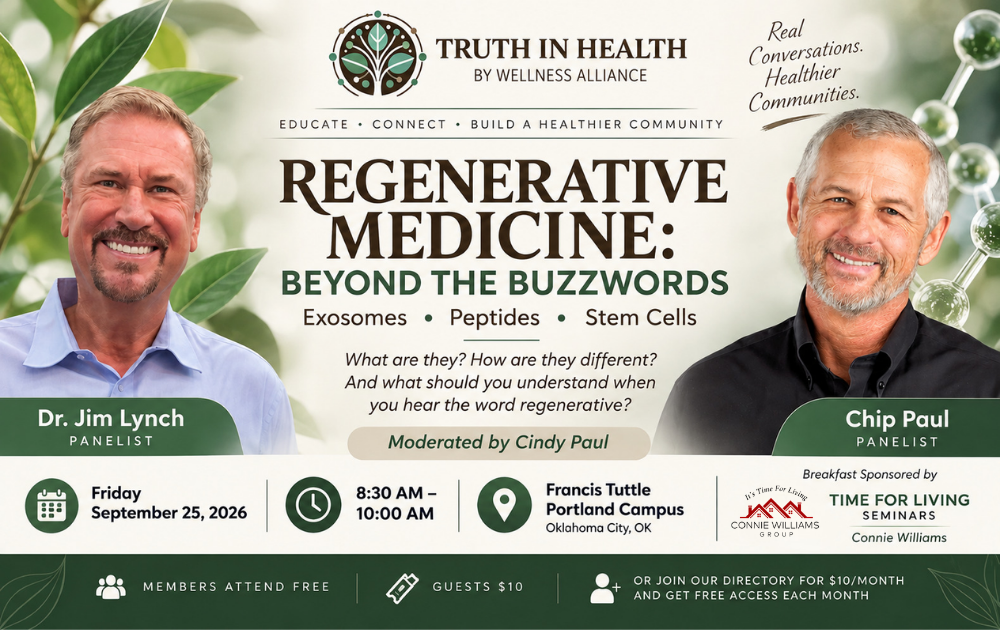
Regenerative medicine is moving quickly—and patients are hearing more about stem cells, exosomes, peptides, PRP, GLP-1 medications, and other emerging approaches. But promising science also brings important questions.
In this Truth in Health educational panel, Dr. Jim Lynch, MD and Chip Paul explore what patients should understand before considering an emerging therapy, including the evidence, regulatory status, sourcing, testing, potential risks, and the importance of looking at the whole person—not just the treatment.
The goal isn't to tell you what decision to make. It's to help you ask better questions.
Watch the Episode

Listen to the Podcast
Stem cells. Exosomes. Peptides. GLP-1 medications. PRP.
The language surrounding regenerative and emerging medicine is becoming increasingly common—but understanding what these treatments are, what the research actually shows, and what questions patients should ask can be much more difficult.
That was the focus of a recent Truth in Health educational panel featuring Dr. Jim Lynch, MD and Chip Paul, moderated by Cindy Paul, Executive Director of Truth in Health Association.
Rather than asking people to simply accept or reject emerging therapies, the conversation centered on something much more useful:
Ask better questions.
What Does Regenerative Medicine Actually Mean?
Regenerative medicine is a broad term.
During the panel, Dr. Lynch and Chip discussed several very different approaches that are often grouped into conversations about regeneration, including stem cells, extracellular vesicles or exosomes, peptides, PRP, medications, nutrition, and other strategies intended to influence biological processes.
That distinction matters.
These technologies are not interchangeable. They may have very different levels of research, regulatory status, potential benefits, limitations, and risks.
Simply hearing the word regenerative does not tell a patient enough about what is actually being offered.
Start With the Evidence
One of the strongest themes from the panel was the importance of looking beyond marketing and asking what evidence actually supports an intervention.
A laboratory finding is different from an animal study. An early human trial is different from a large controlled clinical trial. And promising research is not the same thing as an established treatment.
When evaluating research, patients and healthcare professionals can ask:
- How large was the study?
- Was there a comparison or control group?
- What outcomes were actually measured?
- Has the research been replicated?
- Was the research conducted in people with a condition similar to mine?
- What do we know about safety as well as potential benefit?
The goal isn't to dismiss emerging science. It's to understand where that science currently stands.
Ask What Is Actually Going Into Your Body
One of the most practical discussions during the panel came from an audience question:
How does a patient know what they're actually getting?
That question becomes especially important when considering an injectable, biologic, compounded product, peptide, cellular product, or other emerging intervention.
Patients can ask:
- What exactly is the product or procedure?
- Who manufactures or processes it?
- Where is it manufactured or processed?
- What testing is performed?
- Can the provider explain or provide the available quality documentation?
- What evidence supports its use for my particular condition?
- What is its current regulatory status?
Terms such as FDA registered, listed in a clinical trial database, compounded, investigational, and FDA approved do not all mean the same thing.
Patients should feel comfortable asking their healthcare professional to explain those distinctions.
Manufacturing and Testing Matter
Two products described by the same general name may not necessarily be identical.
Source material, manufacturing processes, handling, storage, testing, purity, sterility, consistency, and other quality considerations can matter—particularly with products intended to be injected or otherwise administered into the body.
This is another reason patients should look beyond the name of a therapy and ask questions about the actual product being used.
Compounding terminology can also be confusing. References to 503A pharmacies and 503B outsourcing facilities, for example, describe different regulatory frameworks. Those designations should not be treated as simple guarantees that a particular treatment is appropriate, effective, or FDA approved for an individual patient.
Ask what the designation means—and what it does not mean.
The Technology Isn't the Whole Patient
Dr. Lynch repeatedly brought the discussion back to something much more familiar: understanding the individual patient.
- Medical history
- Family history
- Current conditions and medications
- Sleep
- Physical activity
- Nutrition
- Goals and expectations
- Lifestyle
Those factors don't disappear simply because a technology is new or sophisticated.
A regenerative intervention may be one part of a much larger healthcare conversation.
Don't Forget the Foundation
One of the memorable analogies from the panel compared advanced healthcare interventions to caring for a valuable car.
You wouldn't ignore the engine, maintenance, fuel, and overall condition of the vehicle and expect an expensive finishing treatment to solve everything else.
The same basic principle can be useful when thinking about health.
Nutrition, movement, sleep, metabolic health, existing medical conditions, medications, environmental exposures, and other foundational factors may all be relevant to a person's overall health.
That does not mean improving those factors guarantees that a regenerative therapy will work.
It means advanced technology doesn't make foundational health irrelevant.
7 Questions to Ask Before Considering Regenerative Medicine
1. What exactly is the treatment, product, or procedure being recommended?
Ask for the actual name and description—not simply a broad term such as “stem cells,” “exosomes,” or “peptides.”
2. What evidence supports using it for my specific condition?
Ask what type of studies have been conducted and how closely those studies resemble your situation.
3. What is its current regulatory status?
Is this an FDA-approved use, an investigational intervention, a compounded preparation, or something else?
4. Who manufactures or processes it, and where?
Ask about sourcing and the organizations responsible for producing or processing what will be administered.
5. What testing and quality documentation are available?
The appropriate testing depends on the type of product, but your provider should be able to explain what quality controls are relevant.
6. What are the known risks, uncertainties, and alternatives?
A meaningful healthcare discussion should include what is known, what isn't known, and what other options may be available.
7. What aspects of my overall health should we address before I decide?
Ask whether medical conditions, medications, nutrition, sleep, metabolic health, activity, or other factors should be evaluated as part of the decision.
Education Before Hype
Regenerative medicine is developing quickly.
Some areas have substantial clinical experience. Others remain actively under investigation. And the evidence can differ dramatically depending on the specific product, procedure, condition, and patient.
Truth in Health's role is not to tell patients that every emerging therapy is good—or that every emerging therapy is bad.
Our role is to encourage informed conversations, better questions, responsible education, and greater transparency between patients and healthcare professionals.
Promising science is worth exploring.
Promising science is not the same as a promised outcome.
Educational Disclaimer: This article and accompanying panel are provided for general educational and informational purposes only and are not medical advice. Statements made during the panel represent the perspectives of the individual speakers. Products, procedures, medications, and emerging therapies can differ significantly in evidence, regulatory status, quality, potential benefits, and risks. Always discuss individual healthcare decisions with an appropriately licensed healthcare professional.
View Full Transcript
Regenerative Medicine: What Patients Need to Know
Truth in Health Educational Panel
Panelists: Dr. Jim Lynch, MD and Chip Paul
Moderator: Cindy Paul, Executive Director, Truth in Health Association
The following transcript has been lightly edited for readability. Statements represent the perspectives of the individual speakers.
Introduction
Cindy Paul:
Today's conversation is really about better questions, healthcare, where healthcare is going, and what regenerative medicine may mean for patients, physicians, and the future of care.
We've got Chip and Dr. Lynch. Dr. Lynch, would you mind giving us an introduction?
Dr. Jim Lynch:
My name is Dr. Jim Lynch. I received my undergraduate degree locally at UCO, which was Central State when I attended. Go Broncos!
I went to the University of Oklahoma College of Medicine and graduated in 1993, followed by three years of residency in family medicine and board certification.
I was in a very busy private practice in Edmond for about five years, and then I decided I wanted to learn more about chronic disease. I spent five years with the Indian Health Service, working with the Citizen Potawatomi and Sac and Fox. I saw a lot of diabetes, heart failure, chronic kidney disease, and other chronic conditions.
I later became a hospitalist, taking care of very sick patients and seeing the end stages of chronic disease, including patients in the ICU.
Then I wanted to better understand chronic pain. I worked in pain management for about five years and saw the problems surrounding chronic pain, how the brain perceives pain, and opioid dependence and addiction. I began treating opioid addiction as well.
Now I work in Direct Primary Care. One of the things I love about it is being able to spend an hour with a patient. That's the big picture of my background.
Cindy:
All right. Chip?
Chip Paul:
It's hard to describe myself. I'm a mathematician, a chaotic-math guy, and a systems theorist. I've always been good at looking at the big picture.
In health, I've worked on a white paper with Dr. Artemis Simopoulos on dietary omega-3 and omega-6 fats. I've also convened a PhD panel of experts on the endocannabinoid system, metabolic health, cellular dysfunction, and the omega-3/omega-6 issue.
I've worked on education surrounding the endocannabinoid system and continue trying to bring awareness to these subjects at a high scientific level.
What Is Regenerative Medicine?
Cindy:
Dr. Lynch, when someone walks into your office asking about regenerative medicine, how do you explain what it is and where it fits within the broader world of healthcare?
Dr. Lynch:
Regenerative medicine is a broad and exciting field. It involves rebuilding, restoring, or replacing cells within our tissues and helping restore biological function.
Some common things people have heard about include stem cells. For example, with degenerative arthritis of the knee and degenerative cartilage, the hope is that stem-cell approaches may help with regeneration in the appropriate environment.
People have also heard about peptides such as GLP-1 medications, including semaglutide and tirzepatide.
These peptides have helped many people lose weight. Obesity is associated with many chronic diseases, including obstructive sleep apnea, diabetes, heart problems, and kidney problems.
We're also continuing to learn more about GLP-1s. Patients sometimes report changes beyond weight loss, including changes in cravings. There's a tremendous amount of research occurring in this area, and more therapies are being studied.
Cindy:
Thank you, Dr. Lynch.
Chip, Dr. Lynch explained what regenerative medicine means clinically. What's happening at the cellular level that makes this area of science so interesting?
Looking at Regeneration From the Cellular Level
Chip:
We're essentially a big collection of cells. At some point, cells cooperate to build a heart, and that heart has to cooperate with the liver, kidneys, and everything else.
Understanding cellular communication is very important, as is understanding what a cell needs.
From my perspective, three major things affect cellular function: nutrition, infection or inflammation, and environment.
When we talk about regeneration, we're really talking about understanding why the body successfully renews certain tissues while other areas scar or fail to completely regenerate.
Regeneration also has to be tightly controlled. Uncontrolled cellular growth can be dangerous, so the body has safeguards.
I think of these as a series of gateways.
Is it safe?
What's happening with the immune system?
Is there excessive inflammation?
Can the area be properly cleared?
Does the body have the nutrients and structural materials needed?
Do we have adequate vitamins, minerals, trace elements, collagen, and essential fats?
Those are the kinds of foundational questions that interest me when looking at regeneration.
Stem Cells, Exosomes and Peptides
Cindy:
Thank you, Chip.
Dr. Jim, we hear so much about stem cells, exosomes, and peptides. What are the key differences patients should understand?
Dr. Lynch:
Stem cells are rudimentary cells that can become different types of cells under certain conditions.
Exosomes are another very exciting area of research. They're small vesicles produced by cells that participate in cellular communication. They can carry signals that influence what other cells do.
There's research occurring around exosomes in a variety of areas, and we're still learning a great deal.
Then there are peptides. Peptides are short chains of amino acids. We have peptides throughout the body, and they can act as hormones or messengers. GLP-1 is one example.
There's a tremendous amount of research coming in all of these areas.
Cindy:
Dr. Lynch has explained some of the differences between stem cells, exosomes, and peptides.
Chip, why are researchers particularly interested in extracellular vesicles and exosomes?
Chip:
Dr. Jim covered a lot of it.
Cells package different materials into vesicles. Those vesicles are involved in communication between cells.
The interesting question in regeneration is how cells understand their environment and communicate whether it's appropriate to repair, grow, or stop.
We already have stem cells in our bodies. Our blood system renews, our gut lining turns over, and renewal is happening throughout the body.
The interesting research question becomes: Why does regeneration occur successfully in some places and not others?
That's one reason extracellular vesicles and exosomes are attracting so much attention.
How Do We Evaluate Emerging Research?
Cindy:
Dr. Jim, as a physician, what questions do you consider most important when evaluating an emerging regenerative technology?
Dr. Lynch:
What were the studies?
What was the efficacy of the study?
And really importantly, what was the safety? What were the side effects?
Those are important things when understanding research.
Something can look promising in a test tube and then produce different results when you move into animal studies and human studies.
That's why you have to look at the evidence as it progresses through different levels of research.
For me, the big picture is safety and efficacy.
Cindy:
That makes sense.
Chip, people see headlines about breakthroughs all the time. How do you read research without getting ahead of what the science actually shows?
Chip:
That's a hard problem for all of us right now because we're surrounded by TikTok videos and a tremendous amount of information.
The traditional approach is to go to sources such as PubMed and understand the research that's available. But you also have to understand the quality of the research.
A very small study isn't necessarily equivalent to a large, properly controlled clinical study.
You have to ask: How was the research conducted? How many people participated? What controls were used? What's the quality of the study?
AI is also becoming a tool people can use to help navigate scientific literature. You can ask it to identify PubMed studies, examine study design, and help you understand the strength or limitations of the research.
But ultimately, the goal is still discernment—understanding what the evidence actually says rather than simply following a headline.
The Healthcare System and Emerging Medicine
Cindy:
Dr. Jim, you've spoken about some of the challenges in our healthcare system. Many patients feel caught between traditional medicine, insurance limitations, and newer options.
How do you see regenerative medicine changing that relationship?
Dr. Lynch:
There are frustrations within the current healthcare system, particularly around insurance and the amount of time physicians are able to spend with patients.
That's one of the reasons I enjoy Direct Primary Care. I can spend more time understanding the patient rather than rushing through an appointment.
As emerging therapies develop, physicians need enough time to talk with patients about their history, goals, expectations, risks, and the evidence behind different options.
Manufacturing, Sourcing and Quality
Cindy:
As more regenerative products become available, what should physicians and patients understand about manufacturing and testing?
Chip:
This is going to become increasingly important.
With emerging products, patients and physicians need to ask where something was manufactured, who manufactured it, what testing was performed, and what documentation exists.
You need to understand the source of the product and the quality-control process.
If you're talking about peptides, exosomes, stem-cell-related products, or other interventions, don't just accept the name of the product.
Ask:
Where was it made?
Who made it?
How was it tested?
What is actually in it?
What is its regulatory status?
Those questions matter.
Looking at the Whole Patient
Cindy:
Dr. Lynch, when you're evaluating someone for an emerging therapy, how important is it to look beyond the specific treatment and evaluate the whole patient?
Dr. Lynch:
It's very important.
I want to know their past medical history and family history. I want to understand their sleep, activity, nutrition, existing conditions, and medications.
And I want to know their expectations.
What do you want to accomplish?
If you have an arthritic knee, maybe your goal is simply, “I want to be able to walk my dog.”
Those individual goals matter.
You want to understand what's appropriate for that specific person rather than treating everyone exactly the same.
Cindy:
And that expectation and outcome is something you want to make sure they're ready for?
Dr. Lynch:
Yes.
Why Foundational Health Still Matters
Cindy:
Chip, Dr. Lynch has talked about looking at the whole patient.
From your perspective, why do foundational health and the body's interconnected systems remain important as we study emerging technologies?
Chip:
Again, we're a collection of cells and systems that have to communicate with one another.
The heart doesn't exist independently of the immune system, the endocannabinoid system, the gut, the liver, or everything else.
If we look at somebody as just a liver, just a gut, just a heart, or just a set of lungs, that's not really a complete view of the person.
We have to begin looking at people more holistically.
Metabolic health, nutrition, infection, inflammation, environment, and cellular communication all become part of that larger picture.
I think we're still very early in understanding how much potential exists in human biology.
Preparing the Body
Cindy:
That completes our prepared questions.
Dr. Jim, do you have any final thoughts before we move on to audience questions?
Dr. Lynch:
In the big picture, nutrition is very important when we're considering many of these regenerative approaches.
Think about having a beautiful Corvette that you're preparing for a car show. You've got this expensive, space-age wax that's supposed to make it look beautiful.
But you bring the Corvette in and the hood is covered with bird poop and there's mud on the fenders.
If you start waxing the car without cleaning it first, is it going to look good?
No.
We need to clean the car first so the wax can do its job.
That's how I think about preparing the body. We look at nutrition and other foundational factors before beginning some of these approaches.
Cindy:
I like that analogy. People know how to take care of their cars!
Dr. Lynch:
Exactly. Relate it to your body.
Audience Questions
“How Do I Know What I'm Getting?”
Audience Member:
As a consumer, what questions am I asking?
If I want to make changes to my health and I'm considering regenerative injections, how do I know what I'm getting? What's going into my body?
Is it synthetic? Is it amino acids?
There's a lot of information for the average consumer to sift through, especially with all these different peptides.
I find myself not even knowing what questions to ask. I'm concerned about what's going into my body, but I don't know what I should ask someone who's offering these treatments.
Chip:
That's a really important question.
With any of these interventions, you want to know the regulatory status of what you're considering.
You want to ask:
Where is it made?
Who's making it?
What's the company behind it?
Where's the data?
With autologous procedures, where material comes from the patient's own body, you still want to understand the physician's process, how things are handled, and the safety procedures.
Peptides are another area where sourcing and testing become extremely important.
Ask what laboratory manufactured the peptide. Ask where the laboratory is located. Ask what testing has been performed.
Patients need to become comfortable asking these questions.
Cindy:
And we can put together that patient questionnaire: What are the questions you need to ask your doctor before you receive one of these products or treatments?
That's something we can work on together.
Chronic Disease Education and Physician Referrals
Cindy:
Any more questions? Connie?
Connie:
I'm Connie, and I'm a registered nurse. I've been doing women's health for 30 years.
I've worked with providers around chronic disease management and patient education—helping people understand how to take care of their bodies and what foods to eat, especially when they're dealing with things such as heart disease, diabetes, or GLP-1 medications.
One issue I'm running into involves physicians referring patients for those services and using the appropriate CPT codes.
What advice would you give for working with DPC practices, wellness practices with physicians, or other medical clinics?
Dr. Lynch:
The best I can say is that perhaps some physicians aren't aware of the CPT codes or the services available.
It seems like it could be a win-win situation. If there's an appropriate service available for the patient and an appropriate way to bill for it, physician education may be part of the issue.
Connie:
Thank you.
Where Does Epigenetics Fit?
Audience Member:
There's a term I haven't heard today, and I'm wondering how it fits into this conversation: epigenetics.
Chip:
Everybody has to start somewhere. Your genetics are your baseline.
But from the moment you're interacting with your environment, your biology has to adapt.
Epigenetics involves processes that affect gene expression without changing the underlying DNA sequence. Two processes often discussed in that context are acetylation and methylation.
Your environment, nutrition, infection, inflammation, and metabolism can all interact with biological regulation.
The larger point is that our biology isn't simply static. There are regulatory systems continually responding to what's happening around and within us.
Do GLP-1s Address the Root Problem?
Tammy:
There's a lot of talk about GLP-1s.
A lot of people are using them, but are GLP-1s actually getting to the root of the problem?
They're helping people lose weight, but do they address what caused the problem in the first place?
Dr. Lynch:
That's a good point.
GLP-1s work in a couple of ways. One involves signaling satiety—helping signal to the brain that you're full.
They also delay gastric emptying, so food remains in the stomach longer.
But to your point, we also need to address behavior.
When we put people on GLP-1s, we talk about protein intake, water intake, and other behavioral changes that support weight loss.
The challenge is helping people continue those healthier behaviors if they eventually stop the medication.
If someone returns to the same behaviors that contributed to the original problem, weight regain can occur.
That's one of the challenges physicians face—helping people make sustainable behavioral changes.
Cindy:
Behavior is probably the hardest thing to change.
Dr. Lynch:
Yes.
Stem Cells and Vision Research
Cindy:
Bernita?
Bernita:
I work for NewView Oklahoma, a low-vision rehabilitation center.
There's research looking at stem cells and whether they may eventually help regenerate the retina or address certain eye diseases.
Do you see some of the things you're discussing today potentially being used in that area?
Chip:
There's definitely interesting research involving the eye and regenerative medicine.
The eye is incredibly sophisticated, and oxidative stress and cellular regulation are important areas of study.
There's promise in stem-cell research and other regenerative approaches involving retinal cells.
But delivery and safety are critical questions.
I'd want to look specifically at where the research currently stands for different eye conditions rather than generalizing across all of them.
Should a Patient's Beliefs Be Part of the Conversation?
Cindy:
We have time for one more question. Becky?
Becky:
I've been a PA for 34 years, and I'm going into private practice.
I'm creating the forms I want patients to complete, and I've been thinking about whether I should include a question about a person's belief system.
Over the years, I've seen that people's beliefs about getting better—and whether they believe God or prayer is involved or none of that is involved—can affect how they approach their health.
Would understanding someone's belief system be a good question to include?
Dr. Lynch:
Personally, I think that's a fantastic question.
Some people may think, “This is simply my lot in life.”
Others may believe strongly that they can improve and want to do everything possible.
Understanding how the patient thinks about their condition and their expectations can be valuable.
Chip:
I agree. That's a really good question.
Closing
Cindy:
Thank you, everyone. Those were great questions.
We're about out of time, so we'll wrap it up.
If you're not already a member of Truth in Health, we'd love for you to join us, become part of the directory, or join as a Founder.
Our Founders have opportunities to present at our meetings, allowing us to highlight different people and areas of expertise throughout the year.
Thank you to Dr. Jim Lynch, Chip Paul, and everyone who participated in today's conversation.
Educational Disclaimer: This transcript is provided for educational and informational purposes. Statements and opinions expressed during the panel belong to the individual speakers and should not be interpreted as medical advice or as positions endorsed by Truth in Health Association. Emerging and regenerative therapies vary significantly in their evidence, regulatory status, potential benefits, quality, and risks. Discuss individual healthcare decisions with an appropriately licensed healthcare professional.


