
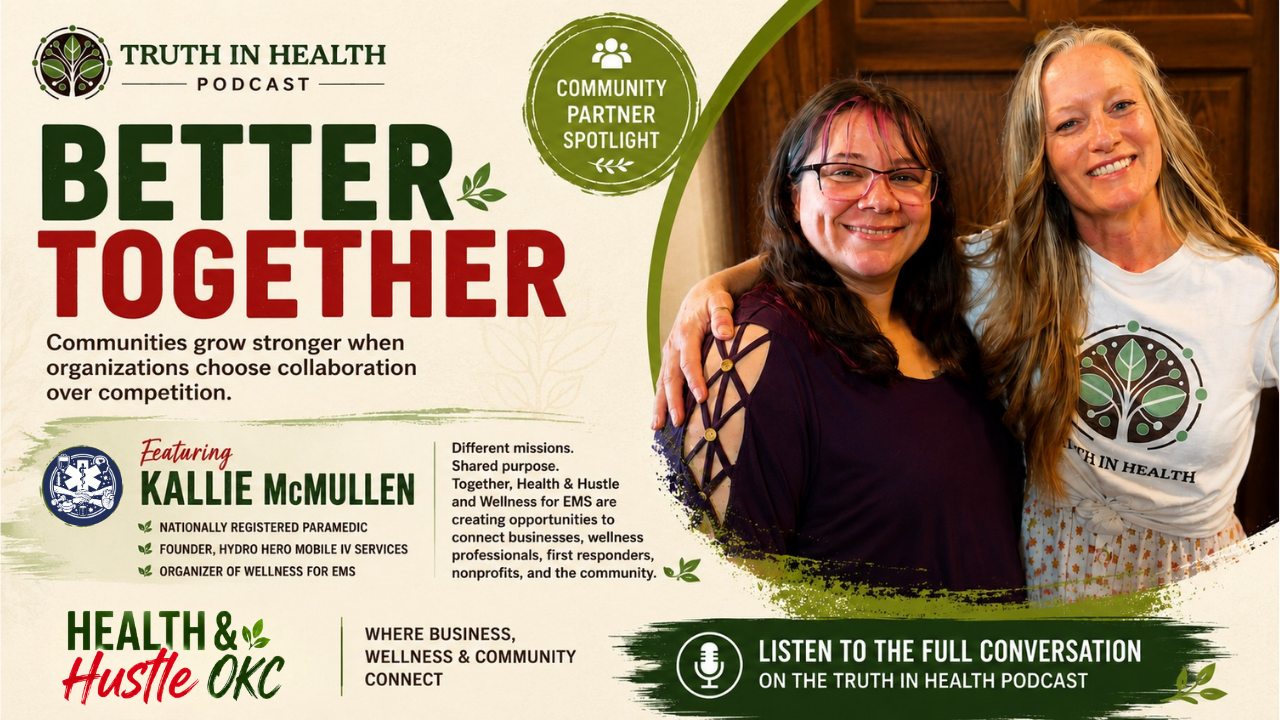
Cindy Paul sits down with nationally registered paramedic Kallie McMullen to talk about first responder wellness, burnout, hydration, prevention, and the work behind Wellness for EMS—and why collaboration can strengthen both healthier people and healthier communities.
Episode Timestamps
- Meet Kallie McMullen
- From the Ambulance to Advocacy
- The Hidden Challenges Facing First Responders
- Why Prevention Matters
- Hydration Is More Than Drinking Water
- Business, Wellness, and Community
- Health & Hustle: Better Together
- Key Takeaways
- About Wellness for EMS
- About Health & Hustle OKC
- Full Podcast Transcript
Watch the Episode

Listen to the Podcast
Meet Kallie McMullen
For nearly two decades, Kallie McMullen has worked on the front lines of emergency medical services. As a nationally registered paramedic, she's cared for people during some of the most difficult moments of their lives, responding to emergencies where every second matters.
Interestingly, EMS wasn't originally part of her plan. Growing up with a father who worked as an EMT, she initially wanted a different career path. A part-time dispatcher position while attending college unexpectedly introduced her to emergency medicine, and after earning her EMT certification, she discovered a passion for serving others that would shape the next 19 years of her life.
Those years gave Kallie a perspective that few people ever experience. She saw the importance of rapid emergency care, but she also noticed something else: many emergencies weren't completely unexpected. People often ignored warning signs, delayed seeking care, or struggled with chronic issues that might have been addressed earlier through education, prevention, and healthier daily habits.
That realization continues to influence her work today. Connect with Kallie
The Hidden Challenges Facing First Responders
When most people think about EMS, they picture flashing lights, ambulances, and lifesaving interventions.
What they don't often see is everything happening between those emergency calls.
-
Long shifts.
-
Interrupted sleep.
-
Meals grabbed from convenience stores.
-
High stress.
-
Repeated exposure to trauma.
Kallie explained that first responders frequently put everyone else's needs ahead of their own. By the time they finish a 14- or 16-hour shift, preparing healthy meals, exercising, or prioritizing recovery can feel nearly impossible. Many rely on fast food, energy drinks, and whatever is available during the workday simply because there are few other options.
Mental health is another challenge that often goes unseen. EMS professionals regularly witness traumatic events, yet they may have little opportunity to process those experiences before responding to the next call. Over time, that emotional burden can contribute to burnout, compassion fatigue, and other long-term challenges.
Supporting first responders means recognizing that the people who care for our communities also deserve care themselves.
Prevention Starts Before the Emergency
One of the strongest themes throughout our conversation was prevention.
Healthcare often begins after something goes wrong.
But true wellness begins long before a crisis occurs.
Listening to your body.
Getting enough sleep.
Staying hydrated.
Supporting proper nutrition.
Managing stress.
Seeking help before problems become overwhelming.
These aren't dramatic interventions, but they can have a significant impact on long-term health.
Kallie shared that many of the emergencies she responded to involved people who had experienced symptoms for days—or even weeks—before finally calling for help. While emergencies can't always be prevented, paying attention to early warning signs can sometimes reduce the severity of future health challenges.
That message aligns closely with the educational mission of Truth in Health: helping people make informed decisions that support their overall well-being.
Hydration Is More Than Drinking Water
Hydration became another important part of our discussion.
Most people know they should drink more water, but hydration is about much more than simply carrying around a water bottle.
Proper hydration supports circulation, temperature regulation, physical performance, energy production, and mental clarity. It also works together with nutrition, electrolytes, and other foundational aspects of health.
Kallie's experience eventually led her to establish Hydro Hero Mobile IV Services, providing mobile IV hydration and wellness services throughout the community. Rather than viewing hydration as a quick fix, she sees it as one piece of a broader approach to supporting overall wellness.
As with every wellness decision, individuals should consult qualified healthcare professionals to determine what approaches are appropriate for their own circumstances.
Why Business and Wellness Belong Together
One of my favorite moments in the conversation came when we discussed why wellness belongs in business conversations.
Business owners, nonprofit leaders, first responders, healthcare professionals, and entrepreneurs all share something in common.
They spend much of their time taking care of everyone else.
Too often, they forget to take care of themselves.
At Health & Hustle, we believe:
How we perform personally impacts how we perform professionally.
Healthy leaders make better decisions.
Healthy teams create stronger organizations.
Healthy organizations strengthen communities.
That philosophy is what inspired Health & Hustle in the first place.
Better Together
One of the reasons I invited Kallie onto the podcast wasn't simply to talk about hydration or emergency medicine.
It was because our organizations represent something larger.
Truth in Health focuses on education and community connection.
Wellness for EMS focuses on supporting first responders.
Neighborly Wellness provides wellness education and services.
Networking organizations connect local professionals.
Each has a unique mission.
Together, those missions create something bigger than any one organization could accomplish alone.
That's the heart of Health & Hustle.
Different missions.
Shared purpose.
Stronger community.
Key Takeaways
- First responders face unique physical and emotional challenges.
- Prevention begins with everyday habits like hydration, nutrition, sleep, and stress management.
- Wellness education empowers people to make informed choices.
- Healthy leaders build healthier businesses.
- Collaboration creates stronger communities than competition.
- Supporting those who serve others benefits everyone.
About Wellness for EMS
Wellness for EMS was created to connect first responders with trusted wellness resources, education, and community support. Through events, partnerships, and ongoing collaboration, the organization works to improve the well-being of the men and women who dedicate their lives to serving others.
Learn more by following Wellness for EMS on Facebook.
About Health & Hustle OKC
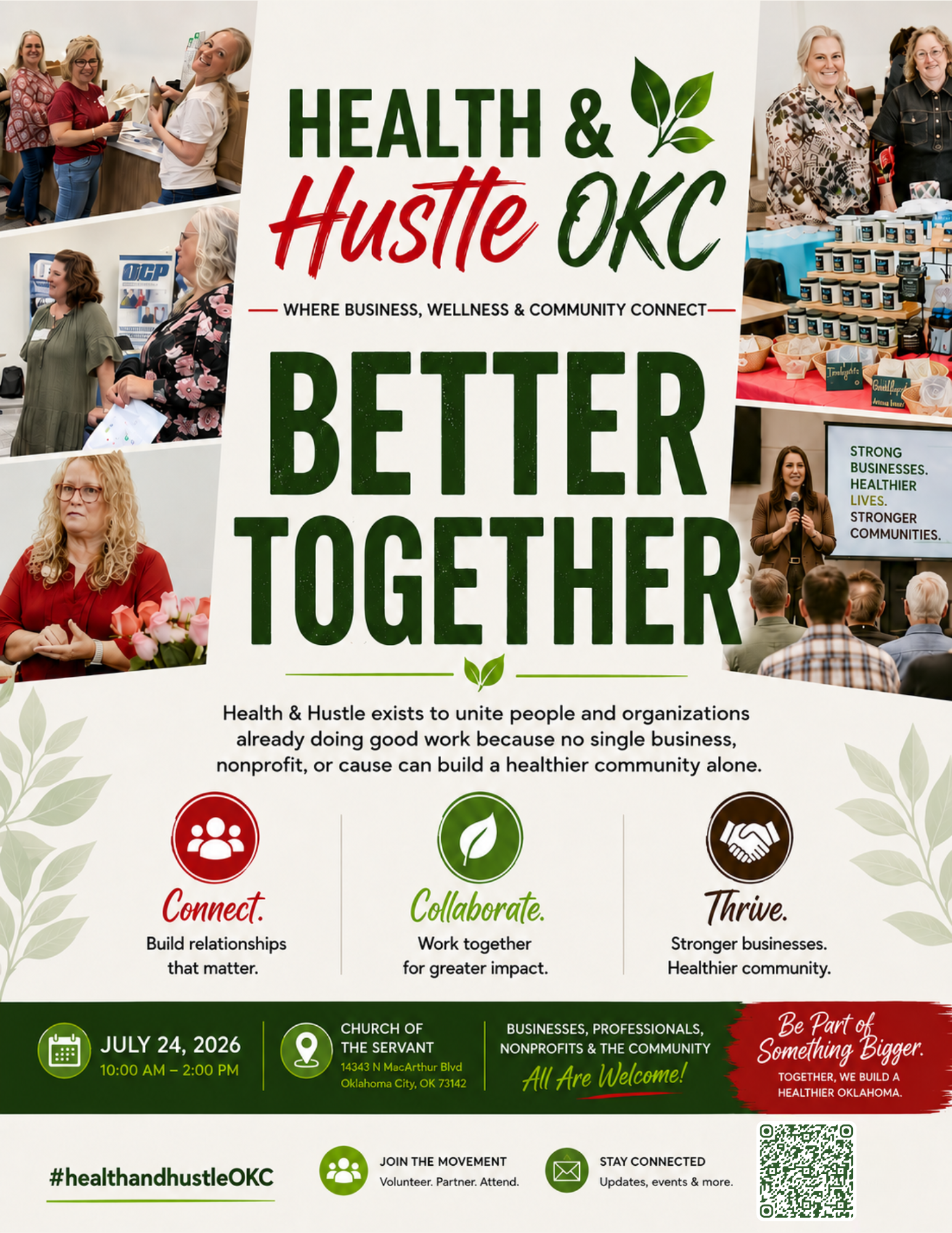
Health & Hustle OKC is more than a networking event.
It's a community collaboration.
Our mission is to bring together entrepreneurs, business professionals, wellness providers, nonprofits, networking organizations, first responders, and community leaders to build stronger businesses, healthier people, and a more connected community.
Whether you're looking to grow your business, improve your health, discover trusted local resources, or simply meet people making a positive difference, there's a place for you at Health & Hustle.
📅 Friday, July 24, 2026
🕙 10:00 AM – 2:00 PM
📍 Church of the Servant – Oklahoma City
We hope you'll join us.
About Truth in Health
Truth in Health Association exists to connect individuals, businesses, wellness professionals, nonprofits, educators, and community organizations through trusted health education, collaboration, and meaningful community engagement.
Through educational events, business networking, podcasts, articles, and community partnerships, our mission is simple: https://www.truthin.health/
Helping people make informed decisions that lead to healthier lives and stronger communities.
Final Thoughts
One thing stood out to me after recording this conversation.
Communities don't become stronger because one organization has all the answers.
They become stronger when people who care about others choose to work together.
I'm grateful to Kallie for sharing her story, for her years of service as a paramedic, and for partnering with us to help make Health & Hustle a place where businesses, wellness professionals, first responders, and community organizations can connect, learn, and grow together.
Because together, we really are better.
Continue the Conversation
If you enjoyed this episode, please:
- Subscribe to the Truth in Health Podcast
- Share this episode with someone who would benefit from the conversation
- Attend Health & Hustle OKC to meet organizations making a difference throughout our community
- Explore additional articles and podcast episodes at Truth in Health
Together, we can build stronger businesses, healthier people, and a more connected community.
View Full Transcript
Truth in Health Podcast – Episode 5
Better Together: Why First Responder Wellness Matters
Host: Cindy Paul
Guest: Kallie McMullen, Nationally Registered Paramedic, Founder of Hydro Hero Mobile IV Services, Organizer of Wellness for EMS
Introduction
Cindy Paul:
Hi everyone! I'm Cindy Paul, Executive Director of Truth in Health.
Today I'm joined by Kallie McMullen from Hydro Hero Mobile IV Services. She's also the driving force behind Wellness for EMS, an initiative dedicated to supporting first responders through education, wellness resources, and community partnerships.
Kallie has spent 19 years as a paramedic, so today we're going to hear about that experience—what she's learned, what she's witnessed, and how those experiences inspired her to create Wellness for EMS and Hydro Hero.
We'll also talk about why she's joining us at Health & Hustle and how our organizations are working together to build healthier, stronger communities.
Kallie is also a Truth in Health Directory Member, and one of our goals is to introduce you to the incredible professionals in our community so you know where to turn when you're looking for trusted wellness resources.
Kallie, I'm so excited you're here. We've gotten to know each other over the past few months, and the more I learn about you, the more I appreciate your heart for helping people.
So let's start at the beginning.
How did you get into EMS?
How Kallie Became a Paramedic
Kallie McMullen:
Honestly, I tried to avoid it.
My dad was an EMT when I was born, so growing up, EMS was always part of our conversations. I actually wanted to do something completely different because I didn't want to follow in his footsteps.
While I was in college in California, I needed a part-time job that would work around my school schedule. I played water polo, so weekends were really the only time I could work.
My dad's best friend happened to have an opening for a dispatcher. At that age, making twelve dollars an hour sounded pretty great, so I took the job.
Originally, it was only supposed to be temporary. But right after I started, California changed the requirements for dispatchers. You suddenly needed either an EMT certification or a dispatcher certification to continue doing the job.
I looked at both options and thought, "The dispatcher course sounds pretty boring."
So I decided to become an EMT instead.
Once I started the training, I realized I actually loved it. I enjoyed learning the medical side of things, and it quickly became something I was passionate about.
What People Don't Understand About EMS
Cindy:
It takes a very special person to become a first responder.
You're putting yourself into situations where you're helping people during some of the worst moments of their lives, and sometimes you're putting yourself at risk in the process.
What do you think the public misunderstands most about EMS?
Kallie:
The biggest misconception is that we're just a taxi service.
We're not.
We're healthcare professionals.
People sometimes think we simply pick them up and transport them wherever they want to go, but there's so much more involved than that.
We perform our own assessments.
We evaluate the patient's condition.
We're making medical decisions before we ever leave the scene.
Sometimes people get frustrated and say, "Just take me to the hospital. I'm not answering your questions."
But those questions matter.
There are different levels of hospitals, and different emergencies require different facilities.
For example, if someone is having a stroke, we can't simply take them to whichever hospital they prefer. We have to transport them to the appropriate stroke center because every minute matters.
The same is true for burn centers and trauma centers.
Our decisions are based on what's best for the patient—not convenience.
Seeing the Same Problems Again and Again
Cindy:
During your years in EMS, you've seen people during some of the hardest moments of their lives.
Were there patterns you noticed over and over again?
Kallie:
Absolutely.
One of the biggest patterns was people ignoring warning signs.
Many patients waited days—or even weeks—before seeking help.
They often knew something wasn't right, but they delayed seeing a doctor, refilling medications, or following through with treatment.
By the time we were called, the situation had become much more serious than it needed to be.
I'm not talking about unexpected emergencies.
Those happen.
I'm talking about the situations where people had opportunities to intervene earlier.
Many of these patients had experienced the same symptoms before.
In fact, we'd often respond to the same individuals multiple times for the same issues.
Listening to your body and addressing concerns early can make a tremendous difference.
The Biggest Lifestyle Challenge
Cindy:
What lifestyle habits seemed to contribute to the biggest health challenges you were seeing?
Kallie:
Without question—dehydration.
We definitely see it more often during the summer months, but honestly, it's an issue year-round.
Many people struggle with keeping fluids down because of illness or digestive problems.
Others simply don't drink enough water throughout the day.
Our bodies rely on proper hydration for virtually every function.
When people become dehydrated, it affects everything—from metabolism to circulation and overall performance.
Cindy:
We see the same thing in our practice.
So many people simply don't know how to take care of themselves anymore.
That's one of the reasons education is so important.
People need to understand what they can do at home to better support their health, and hydration is one of the simplest places to start.


