
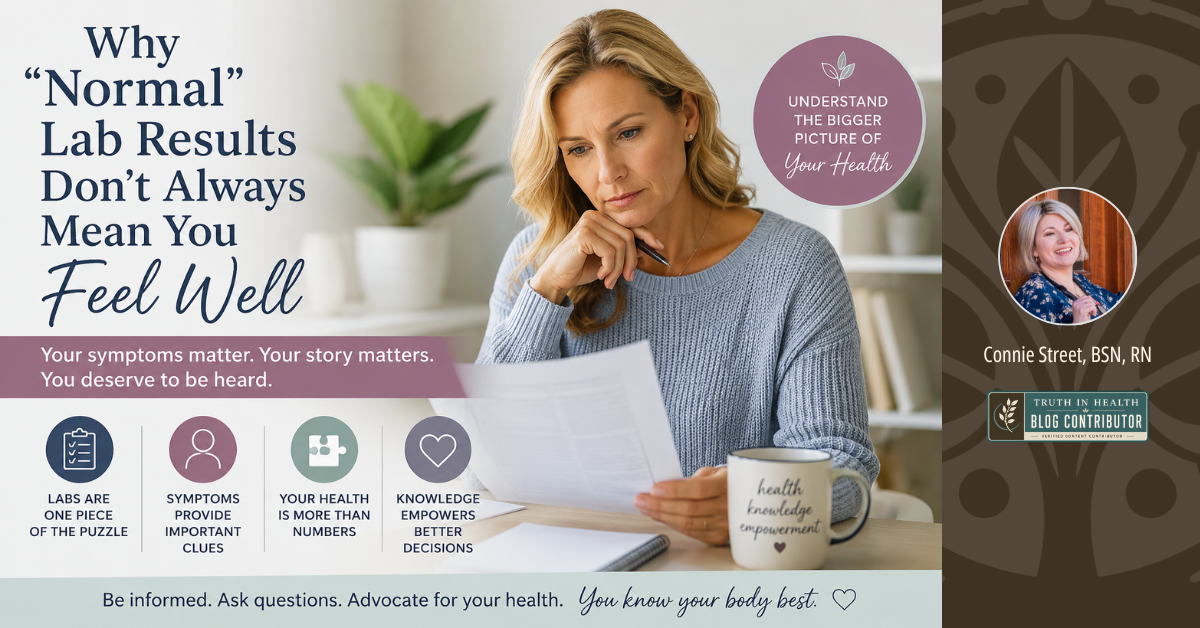
Have you ever been told your lab work is normal even though you still don't feel like yourself? In this article, Connie Street, BSN, RN, explains why laboratory results are only one piece of the wellness puzzle and why symptoms, lifestyle factors, stress, sleep, and hormonal transitions deserve attention too.
Your symptoms matter. Your story matters. You deserve to be heard.
By Connie Street, BSN, RN
Have you ever left a doctor's appointment feeling more confused than relieved?
You finally made the appointment. You discussed your symptoms. You had the lab work completed. Then the call comes:
"Everything looks normal."
But what if you still don't feel normal?
Many women find themselves in this exact situation. They are experiencing fatigue, brain fog, weight changes, poor sleep, mood fluctuations, low energy, or a general feeling that something just isn't right. Yet their laboratory results fall within the standard reference ranges and they are told everything appears normal.
If this sounds familiar, you're not alone.
A Story I Hear Often
A woman in her late 40s reached out because she was frustrated. She told me she was exhausted by mid-afternoon, had difficulty concentrating, wasn't sleeping well, and had gained weight despite not changing her eating habits.
She had already visited her healthcare provider and completed routine blood work. The response she received was that her results were normal.
She wasn't looking for someone to diagnose her. She wasn't looking for a magic pill. She simply wanted to understand why she felt so different than she had just a few years earlier.
As we talked, we explored factors that often don't show up clearly on routine lab reports alone ~ stress levels, sleep quality, nutrition habits, life transitions, activity patterns, and the hormonal shifts that commonly occur during perimenopause.
What she discovered was something incredibly important:
Her symptoms were real.
More importantly, she learned how to track those symptoms, organize her concerns, and have a more productive conversation with her healthcare team.
Knowledge didn't instantly solve every problem, but it gave her confidence and direction.
That is often where meaningful change begins.
What Does "Normal" Really Mean?
One of the biggest misunderstandings in healthcare is the word "normal."
Most laboratory reference ranges are developed using statistical data collected from large populations. If your results fall within that range, they are generally considered normal from a laboratory standpoint.
However, normal does not always mean optimal.
Nor does it mean your symptoms should be ignored.
Laboratory testing is an important tool, but it is only one piece of the puzzle. Your symptoms, health history, lifestyle, stress levels, sleep patterns, and daily experiences all provide valuable information as well.
Healthcare providers use both objective information and clinical judgment when evaluating concerns.
Symptoms Matter
Many women dismiss their symptoms because they feel they should simply push through them.
They tell themselves:
"I'm just getting older."
"I'm probably just stressed."
"Maybe everyone feels this way."
But symptoms are your body's way of communicating.
Common concerns women report include:
- Fatigue
- Brain fog
- Difficulty concentrating
- Weight gain
- Mood changes
- Poor sleep
- Increased stress
- Low motivation
- Changes in menstrual cycles
- Reduced exercise tolerance
These symptoms may be influenced by numerous factors, including sleep habits, nutrition, chronic stress, life circumstances, hormone transitions, activity levels, and overall wellness patterns.
Paying attention to symptoms does not mean assuming something is wrong. It means gathering information.
Why Women Often Feel Dismissed
Most healthcare providers genuinely want to help their patients.
However, today's healthcare environment can be challenging.
Appointments are often short.
Patients may have multiple concerns to discuss.
Complex symptoms can overlap.
Many wellness concerns develop gradually over months or years rather than appearing suddenly.
As a result, women sometimes leave appointments feeling unheard or uncertain about what to do next.
This is why preparation matters.
The more informed and organized you are before an appointment, the more productive that conversation can become.
Looking at the Bigger Picture
When it comes to wellness, there is rarely one single factor responsible for how we feel.
Instead, we often need to consider multiple areas of life, including:
Nutrition
Food provides the building blocks your body uses every day. Eating patterns can influence energy levels, blood sugar stability, recovery, and overall wellness.
Sleep
Poor sleep affects nearly every system in the body. Even small disruptions can impact energy, mood, focus, and resilience.
Stress
Chronic stress can influence behavior, sleep quality, eating habits, motivation, and overall well-being.
Hormonal Transitions
Women may experience significant changes during perimenopause and menopause that affect how they feel physically and emotionally.
Genetics
Genetic nutrition testing can sometimes provide additional insight into how an individual may respond to certain nutrients, foods, and lifestyle factors.
Looking at the bigger picture often helps individuals better understand their wellness journey.
Becoming an Advocate for Your Health
One of the most empowering things you can do is become an active participant in your healthcare.
Consider these simple strategies:
✔ Keep a symptom journal.
✔ Track changes in sleep, energy, mood, and eating habits.
✔ Request copies of your laboratory results.
✔ Write down questions before appointments.
✔ Learn about your health concerns from reputable sources.
✔ Seek education that helps you understand your options.
✔ Maintain open communication with your healthcare providers.
You do not need to become your own doctor.
You simply need to become informed enough to participate in the conversation.
Final Thoughts
If you've ever been told your labs are normal but you still don't feel like yourself, know that your experience matters.
Laboratory testing provides valuable information, but it does not tell the entire story.
Your symptoms, lifestyle, stress levels, sleep quality, nutrition habits, and life experiences are all important pieces of understanding your overall wellness.
The goal is not to self-diagnose.
The goal is to become informed, empowered, and prepared to advocate for your health.
When education and awareness increase, better conversations often follow.
And sometimes, those conversations become the first step toward meaningful change.

About the Author
Connie Street, BSN, RN is the founder of Self Care University OK. She provides wellness education, hormone education, genetic nutrition testing support, meal planning, and wellness coaching to help individuals better understand their health and become informed advocates for their wellness journey.


