
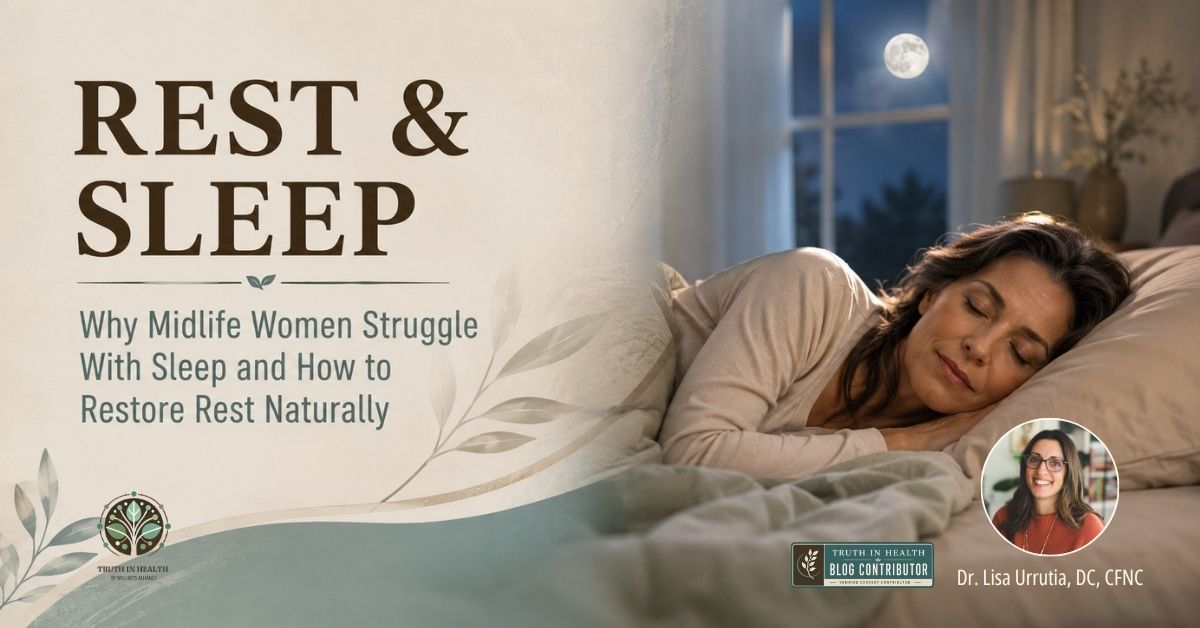
Many women in midlife find themselves lying awake at night, waking at 3 a.m., or feeling exhausted despite getting enough hours of sleep. In this thoughtful article, Dr. Lisa Urrutia explores why sleep often becomes disrupted during this season of life and shares practical, root-cause approaches to help restore rest, resilience, and overall wellness.
Rest and Sleep: The Root You Were Never Meant to Skip
One of the Seven Roots of Wholeness
By Dr. Lisa Urrutia, DC, CFNC
Back in 2011, I was running on a wheel I had built myself. I woke before the sun, moved through the day on caffeine and willpower, and fell into bed long after I should have, certain that rest was something I would get to once everything else was finished. It never was finished. And somewhere in that season, my body stopped asking nicely. The tiredness that used to lift after a good night of sleep settled in and stayed.
If you are reading this in the middle of your own tired season, I want you to know something before we go one step further: you are not lazy, you are not broken, and you are not alone.
Maybe you have started to dread bedtime a little, bracing for another night of staring at the ceiling. I have sat beside so many women who carried that very worry, and I want to offer you a different story. The tiredness you are feeling is not your new normal. It is a conversation your body is trying to start with you.
Your Sleep Is Not Betraying You
For so many women in midlife, sleep is the first thing to fray. You fall asleep fine, then wake at 3 a.m. with a racing mind. Or you lie down exhausted and feel suddenly, frustratingly awake. Or you sleep seven hours and still move through the morning as though you barely slept at all.
This is not a character flaw. It is a signal.
In this season of life, the systems that once managed your sleep without a second thought are shifting. Estrogen and progesterone, the two hormones that help calm the nervous system and stabilize sleep, begin to decline and fluctuate. Progesterone in particular has a soothing, almost sedative quality, and as it dips, the brain can struggle to settle. Cortisol, your stress hormone, can rise at exactly the wrong hour, which is often why 3 a.m. feels so wide awake.
Add the heat of a night sweat, a nervous system that has been running on high for years, and a culture that treats rest as something to be earned, and the picture comes into focus. Your sleep is not betraying you. It is telling you the truth about what your body needs.
Rest Is the Soil Everything Else Grows In
 Here is why this root matters so much. Sleep is not the absence of activity. It is some of the most important work your body does. While you rest, your brain clears the waste it gathered through the day, your hormones recalibrate, your blood sugar steadies, and the tissues that carried you repair.
Researchers who study this, voices like Dr. Matthew Walker and the team at Huberman Lab, keep arriving at the same steady conclusion: nearly every other part of your health—your energy, your mood, your hunger signals, your patience, your resilience—grows stronger or weaker depending on how you sleep.
Poor sleep even nudges the hormones that govern appetite and blood sugar, which is part of why a hard night so often becomes a hard day of cravings and low energy.
Rest is not the reward for a healthy life. It is the soil the rest of your health grows in.
So if sleep has been the thing you keep promising to get to, I would gently invite you to move it from the bottom of your list to the top. Not with pressure. With permission.
Where We Begin, by Subtracting, Not Adding
Notice that we are not piling more onto your already full life. We are removing what gets in the way. We begin gently, and we begin together.
First, we protect the last hour of your day. The hour before bed sets the tone for the night that follows. That means softening the lights, stepping away from the bright screen and the busy news, and letting your body receive the signal that the day is done. This one shift, dimming the world before you ask your body to rest, can change a night more than any supplement on the shelf.
Second, we tend to your mornings as carefully as your nights. A few minutes of natural light early in the day helps anchor your body's internal clock, which in turn helps it know when to release the hormones that bring sleep when evening comes. A short, unhurried walk outside is one of the most generous things you can offer your sleep, and it asks nothing of your wallet.
Third, we look honestly at what keeps the nervous system on high. Caffeine that lingers too late into the afternoon. A glass of wine that quiets you at first but fragments the second half of the night. A mind that never gets permission to set the day down. We do not shame any of these. We simply notice them, one at a time, and ask whether they are serving the rest you long for.
And fourth, because this is a root and not a quick repair, we give it time. Real change in sleep is rarely instant. It comes in small, steady shifts that build on one another, the way a tree puts down roots long before it ever shows new leaves.
Small shifts. Lasting change.
“In peace I will both lie down and sleep, for you alone, O Lord, make me dwell in safety.”
Psalm 4:8
Rest, at its deepest level, is an act of trust. It is laying down the striving, the controlling, and the endless doing, and remembering that you are held by something steadier than your own effort.
Your body was designed to heal. Part of that design is the nightly invitation to stop and be restored.
A Gentle Challenge
Just one small step this week.
Tonight, choose a single hour before bed and make it softer than usual. Dim the lights, set the phone in another room, and let your body begin to power down the way it was made to.
That is all.
One hour. One night.
We take this one step at a time, and we take it together.
You do not have to have everything figured out tonight. You only have to begin.
When You Are Ready, You Do Not Have to Walk It Alone
If your sleep has been trying to tell you something, and you would like a guide beside you as you listen, this is the very work we do at Connected Roots Wellness. We walk alongside women in midlife to uncover the root causes behind tired days and restless nights, and to build a personalized path back to rest, one grounded step at a time.
There is no pressure here and no pushing.
Only a guide who will help you get to your roots.
Rest well, dear one.
You were never meant to run on empty.
About the Author
 Dr. Lisa Urrutia, DC, CFNC
Dr. Lisa Urrutia is the founder of Connected Roots Wellness, a functional nutrition and lifestyle practice in Edmond, Oklahoma. With more than 25 years of experience in whole-person health, she combines her chiropractic background with a root-cause approach to nutrition and wellness. Dr. Lisa is passionate about helping women uncover what is beneath their symptoms, restore balance, and move toward the vibrant health they were made for. She is a proud wife, mother, grandmother, member of a military family, and a Founding Member of the Truth in Health Association.
Dr. Lisa Urrutia is a Founding Member of the Truth in Health Association and founder of Connected Roots Wellness in Edmond, Oklahoma.
This article is for educational purposes only and is not intended as medical advice. Please consult your healthcare provider before making changes to your diet, lifestyle, supplements, or medications, especially if you have existing health conditions.


