
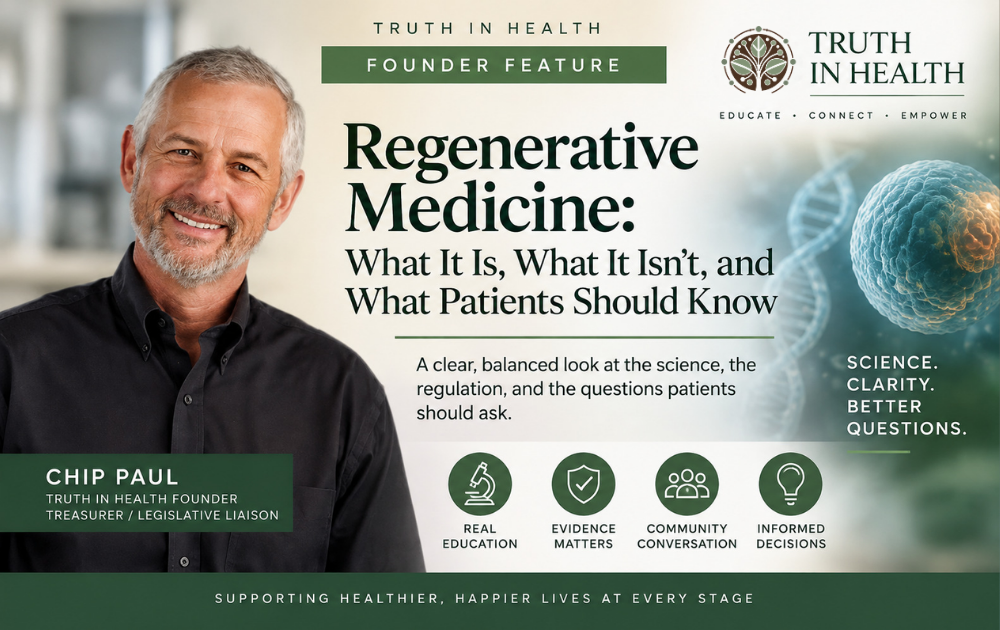
Regenerative medicine is advancing quickly—but stem cells, exosomes, cellular therapies and other technologies don't all have the same evidence or regulatory status. Truth in Health Founder Chip Paul explains the field and the questions patients should know to ask.
Truth in Health Founder Education
Regenerative Medicine: What It Is, What It Isn’t, and What Patients Should Know
Regenerative medicine is becoming part of everyday health conversations. But as interest in this field grows, so does confusion about what regenerative medicine actually means, what is being studied, what has received regulatory approval, and what questions patients should ask before considering a therapy.
You may hear conversations about stem cells, biologics, tissue engineering, gene therapies, exosomes, or treatments intended to repair or restore damaged tissue.
These subjects are often grouped together under the term regenerative medicine, even though they can involve very different technologies, evidence, regulatory pathways, and clinical uses.
At Truth in Health, we believe emerging areas of healthcare deserve more than hype or dismissal.
They deserve education.
What Is Regenerative Medicine?
Regenerative medicine is a broad field focused on developing ways to repair, replace, or regenerate damaged or diseased cells, tissues, and organs.
Research within the field can include areas such as stem cells, engineered biomaterials, tissue engineering, cellular therapies, and gene-based technologies.
That means regenerative medicine is not one treatment.
It is a broad field of science and medicine encompassing different technologies, different levels of evidence, and different clinical applications.
Our Bodies Already Regenerate—Just Not Equally Everywhere
Regeneration itself is not foreign to the human body.
We continuously replace certain cells. Skin repairs after injury. Broken bones can produce new tissue as they heal. The liver also has a remarkable ability to compensate following certain types of damage or partial removal.
But tissues throughout the human body do not all possess the same regenerative capacity.
Researchers are therefore studying ways to better understand and potentially influence repair in tissues where the body's natural regenerative response may be limited.
That scientific exploration is one reason regenerative medicine has generated so much interest.
But there is an important distinction:
Scientific potential and a proven clinical treatment are not the same thing.
Stem Cells Are Only One Part of the Conversation
Stem cells receive significant attention because of their ability to develop into specialized cell types.
But regenerative medicine extends beyond stem cells.
Depending on the area of research or treatment, regenerative medicine may involve cells, engineered tissues, biomaterials, gene-based technologies, or combinations of different approaches.
This distinction matters because consumers may hear the umbrella term "regenerative medicine" applied to products and procedures that are very different scientifically and legally.
Approved Treatments and Investigational Therapies Are Not the Same
One misconception surrounding regenerative medicine is that everything in the field is experimental. Another is that because regenerative medicine is a legitimate scientific field, every treatment marketed under that description has been proven safe and effective.
Neither view adequately describes the field.
The U.S. Food and Drug Administration maintains a list of approved cellular and gene therapy products for specific indications. At the same time, many other regenerative technologies remain under investigation.
The FDA also has a designation known as Regenerative Medicine Advanced Therapy, or RMAT, created to facilitate development and review of qualifying regenerative medicine therapies intended for serious conditions.
An RMAT designation is part of a regulatory development pathway. It should not be confused with FDA approval of a product for general clinical use.
Where Consumers Need to Be Careful
The popularity of regenerative medicine has moved faster than public understanding of how these products are regulated.
The FDA has warned consumers about unapproved regenerative medicine products marketed for diseases and conditions for which safety and effectiveness have not been established.
These warnings have included products marketed as stem cell products, exosome products, Wharton's jelly products, amniotic products, and other human cell or tissue products.
FDA currently states that there are no FDA-approved exosome products.
That statement does not mean exosome research has no scientific value.
It means something much more specific:
Research, investigational use, and FDA-approved clinical use are different categories—and patients deserve to understand which category they are dealing with.
"FDA Registered" Is Not the Same as "FDA Approved"
Regulatory terminology can be confusing, particularly when it appears in marketing.
A company or establishment being registered with the FDA does not automatically mean the FDA has reviewed and approved every product or treatment it offers as safe and effective for a particular condition.
Likewise, the existence of a clinical study does not automatically mean a product has received FDA approval.
Patients should feel comfortable asking exactly what regulatory status applies to the specific product or procedure they are considering.
Questions to Ask Before Considering a Regenerative Therapy
Asking whether "regenerative medicine works" is usually too broad a question.
A better conversation begins with the specific product, procedure, condition, and evidence involved.
Questions worth asking include:
- What exactly is the product or procedure?
- What is its source?
- What is being done to the cells or tissue before they are administered?
- What condition is it being used to treat?
- What clinical evidence supports its use for that particular condition?
- Is this specific use FDA approved?
- If it is investigational, is it being administered as part of an appropriately overseen clinical investigation?
- What are the known risks?
- What uncertainties remain?
- What other treatment options are available?
- Who is responsible for follow-up care if a complication occurs?
Good healthcare decisions should leave room for questions.
Why Regulation Can Get Complicated
Human cells and tissues do not all follow exactly the same regulatory pathway.
The FDA's regulatory framework considers characteristics such as how a human cell or tissue product is processed and how it is intended to be used.
Terms such as minimal manipulation and homologous use can become important in determining how certain human cells, tissues, and cellular and tissue-based products are regulated.
Some products are subject to extensive premarket review as drugs or biological products, while qualifying human cell and tissue products may fall within a different regulatory framework.
This is why broad statements such as "stem cells are legal" or "stem cells aren't FDA approved" do not give consumers enough information.
The specific product, how it is processed, its intended use, how it is administered, and its regulatory status all matter.
Promise Deserves Evidence
There is legitimate science behind regenerative medicine.
There are cellular, gene, and tissue-based therapies with established medical uses. There are also technologies being evaluated through legitimate clinical research.
And there are products being marketed directly to consumers with claims that go beyond what regulators have reviewed or authorized.
Those realities can exist at the same time.
Being excited about scientific advancement doesn't require abandoning healthy skepticism. Asking hard questions doesn't require dismissing innovation.
Where Truth in Health Fits
Truth in Health was created to help bridge information gaps like these.
Our role isn't to tell someone which medical treatment to choose.
Our role is to bring credible education, practitioners, researchers, community leaders, and the public into the same conversation—and help people develop better questions to ask.
Regenerative medicine will continue to evolve. New research will emerge. Regulations will change. Some technologies being investigated today may eventually become established therapies, while others may not demonstrate sufficient safety or benefit.
That's why education cannot be a one-time conversation.
Through educational articles, community discussions, and conversations with professionals working in this field, Truth in Health will continue exploring regenerative medicine while clearly distinguishing established evidence from emerging research.
Innovation deserves curiosity. Patients deserve clarity. Health decisions deserve good information.
About Chip Paul
Chip Paul is a Founder and Treasurer/Legislative Liaison of Truth in Health Association.

Chip is an educator and entrepreneur whose work has included health education, the endocannabinoid system, nutrition, and emerging areas of regenerative medicine. Through Truth in Health, he helps bring practitioners, educators, community leaders, and the public together for conversations about health, innovation, and informed decision-making.
Learn More From Primary Sources
- U.S. Food & Drug Administration — Approved Cellular and Gene Therapy Products
- U.S. Food & Drug Administration — Important Patient and Consumer Information About Regenerative Medicine Therapies
- U.S. Food & Drug Administration — Framework for Regulation of Regenerative Medicine Products
- National Institutes of Health — Tissue Engineering and Regenerative Medicine


